


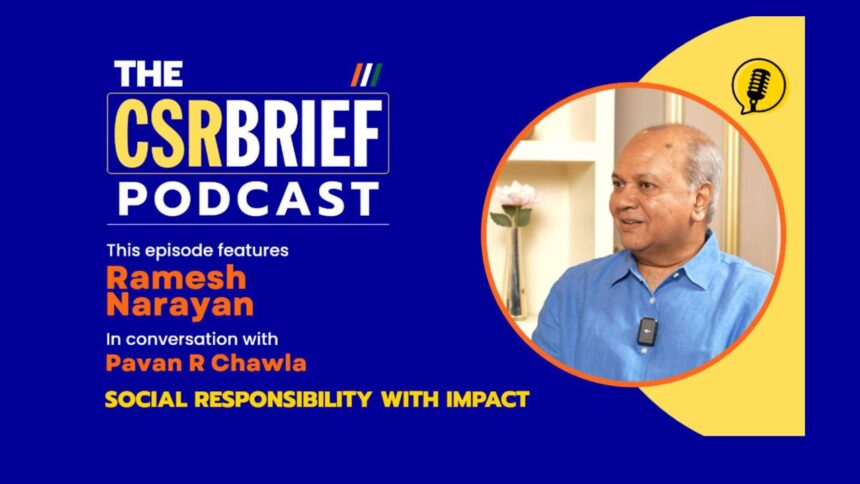
Watch Ramesh Narayan on The CSRBrief Podcast
The first episode of The CSRBrief Podcast features Ramesh Narayan in a conversation that goes straight to the heart of what CSR should be: not merely a cheque or a compliance line, but responsibility translated into participation and action.
Ramesh is a veteran of India’s advertising and marketing industry, with three decades of leadership and service across bodies including the Advertising Club of India, AAAI, IAA and AFAA. He currently serves as Chairman of the Advertising Council of India, and Director Strategy at the Asian Federation of Advertising Associations. His social-service and sustainability work spans education, elder care, disability, women’s safety, environmental action and integrated village development. His honours include lifetime achievement awards from AAAI and AFAA and IAA Hall of Fame inductions, and the IAA Force For Good award.
In this conversation, Ramesh argues that CSR works best when employees step into the field, companies choose causes with care, strong implementation partners do the work, and leadership makes the commitment visible. He brings that philosophy alive through stories of children who were taught to dream and villages where water, solar energy, health, education and livelihoods were connected into one development effort.
There is a larger point about communication too: good work deserves visibility, but not chest-beating or greenwashing. It is a fitting first conversation for CSRBrief, whose baseline is Social Responsibility with Impact. Watch. Listen. Read. Revel.
Why this episode matters
This conversation turns CSR from a statutory line item into a human and organisational practice. Ramesh Narayan connects investment with empathy, employee engagement with corporate culture, implementation with patience, and social impact with the need to communicate good work responsibly. For the first episode of The CSRBrief Podcast, that is exactly the ground worth establishing.
10 Big Ideas from this episode
1. Ramesh Narayan on good CSR starting at the heart — and becoming deeds
Why social responsibility needs conviction first, and then action, commitment and strategy.
2. CSR is an investment, not merely expenditure
Why mandated spending can address real social needs and create value beyond compliance.
3. Good work should be communicated — without chest-beating
Why responsible visibility can amplify a cause and an organisation’s contribution without slipping into greenwashing.
4. Ramesh Narayan on employee participation as CSR’s missed opportunity
Why sending a cheque is not enough when the organisation can also involve its own people in the work.
5. Field experience can change corporate culture
Why firsthand participation can build empathy, fulfilment and pride that presentations and policies cannot create on their own.
6. Start with a real need before obsessing about scale
Why social action can begin small, learn through experience and grow instead of being paralysed by questions of scalability from day one.
7. Bhavishya Yaan shows how education can teach young people to dream
Why school retention, spoken English, computer skills and life skills can open ambitions far beyond the original programme goal.
8. Integrated village development works when interventions connect
Why water, solar energy, health, education, agriculture and livelihoods become stronger when they reinforce one another.
9. Ramesh Narayan on implementation partners, cause fit and leadership backing
Why good execution needs capable partners, a cause that resonates and visible support from the top.
10. Lasting impact needs sustained commitment
Why the deepest outcomes often emerge after organisations stay with a cause long enough for participation, confidence and livelihoods to grow.
In this episode
- Ramesh Narayan’s journey from writing and advertising to social responsibility
- CSR beyond compliance: investment, responsibility and national need
- Sustainability communication, the Olive Crown Awards and avoiding greenwashing
- Employee engagement and CSR as part of corporate culture
- Field experience, empathy and the role of young professionals
- Bhavishya Yaan and the power of teaching children to dream
- Integrated village development: water, solar energy and rural livelihoods
- Implementation partners, cause selection, leadership and lasting impact
- Ramesh Narayan on CSRBrief, Social Responsibility with Impact and the first episode
The Podcast Conversation: Ramesh Narayan on The CSRBrief Podcast
Below is the edited transcript of my conversation with Ramesh Narayan on the first episode of The CSRBrief Podcast. It has been very lightly edited for readability while preserving the substance, examples and flow of the discussion.
Why should you keep saying, ‘Go there on a Sunday’? Make it a part of the work regimen itself. Why not inculcate it into the entire corporate DNA and say that we would like you all to go there and do it? It’s not only about you, it’s about us as well: Ramesh Narayan
(Editor’s note: This episode was recorded ahead of the launch of CSRBrief.com and is being published on 15 August 2026, the launch day of CSRBrief. Any figures, programme counts or time-sensitive references should be read in that context.)
H3: Opening: Ramesh Narayan, CSRBrief and a life of social responsibility
Pavan: Namaste and welcome to The CSRBrief Podcast from our new website CSRBrief.com. I’m Pavan R Chawla and I am humbled and proud to share that this episode that we are shooting with a wonderful industry leader and veteran, will be published on the day we launch our offering – our new website CSRBrief.com – to the Nation on Independence Day, no less.
Let me tell you very quickly about CSRBrief.com. CSRBrief is a news and knowledge publication on CSR and sustainability. It captures, connects and shares the ideas, insights and initiatives shaping the space to inform professionals, inspire meaningful action and to help create lasting impact with purpose.
And our guest on the first episode of The CSRBrief Podcast is Ramesh Narayan, industry leader and enabler of enterprise and. to a great and solidly impactful extent, of corporate social responsibility. Welcome, Ramesh, to CSRBrief and The CSRBrief Podcast and thank you for your time. We are shooting this just three days before the launch, and on a Sunday — which tells me of your commitment to driving purpose with impact.
Ramesh: Thank you so much. It’s an honor to be here. More importantly, on the first episode. And I believe that this entire topic (CSR) is all-important for all of us in India. So, I’m glad to be here. Shoot!
Pavan: Ramesh, before we get into and about CSR, tell me very briefly about your own journey related to CSR, and where your belief in giving back and social responsibility began.
Ramesh: I always loved to write. After school itself, I used to work at the Indian Express and I wrote articles for the Hindu and the Mid-day. However, I was told that – and in those days at least – newspapers were not paying enough, and I liked the nicer things of life as well so I thought that I would like to work as a writer in an advertising agency. But I hadn’t done an MBA or a kind of mass comm course, and I hadn’t seen the inside of an advertising agency.
But I knew that I was eminently unemployable. So I said that the only thing to do was to start an ad agency of my own. And so I did. Probably the only advertising agency that opened its doors without an account at all. And the rest as they say…
Pavan: When did you realize that you always wanted to innately sort of give back this social responsibility element.
Ramesh: So, there were two, I think, steps in that. Number One was that early in the day, I always felt that I should do a little bit of industry work. Advertising industry.
Pavan: Yeah, you do that all the time.
When I began doing social work, the constant refrain I heard was, ‘Are you an expert in this? Do you have expertise in that? Is this thing scalable? Is this thing sustainable? What benefit will my business get?’ Just forget it! Let us start in a small way and see how it goes. And it worked every time: Ramesh Narayan
Ramesh: And it is honorary. So I was involved in all the industry associations; I won’t go into that. And then, as I always say, I open the window, and I see a cause downstairs! And it does affect me. So, I have always felt that, and here’s a line that I use often – I used to always say that if you can wipe one tear, or if you can spread one smile, yours is a life well lived.
And I stress this point because was when I began doing social work, the constant refrain I heard was, ‘Are you an expert in this? Do you have expertise in that? Is this thing scalable? Is this thing sustainable? What benefit will my business get?’ Just forget it..! Let us start in a small way and see how it goes. And it worked every time.
H3: CSR beyond compliance: Responsibility, investment and communication
Pavan: At its very heart, Ramesh, what does corporate social responsibility mean to you? And why must it be seen as a responsibility, really, that goes far beyond mandated expenditure and checkbox compliances?
Ramesh: Number one, I feel that I’m glad that in 2014, they introduced this whole CSR as a compulsory thing. And I felt that it was a great way, because profits are there in any case, and instead of it going elsewhere, it can go for a cause that is good. Unfortunately for India, we have a lot of causes which are good and they have to be addressed. And unfortunately, again, whatever one might say about the government – and I’m not being political here – all the governments, whatever they do, is not enough. It is just not enough.
So it needs corporates to actually step in there and to do their bit. And it’s an ideal situation, I think, because here it’s a must in any case they have to do something, help a good cause, helps a country, and as they are slowly now realising, there are two aspects to this.
Ramesh: That in helping Society, in a way it also helps their own image. And in a very real way. You see, it’s not a fancy ad line saying that, I help this and I do this and I do that. If all these things are actually publicized in the right way, and the right way… if you ask me what is the right way? That’s why we actually thought of the IAA’s Olive Crown Awards.
They are all about actually sustainability. And it first began as excellence in communicating sustainability only. But then we learnt that in that itself you are actually communicating all the good that all these guys are doing, corporates are doing.
Then we introduced categories like corporate, social leader. Then we got Green Crusader, and others too. And the media of course is helpful to all these causes and to us because we are a part of the media, the IAA. So here we found that the corporates were also realizing that entering these awards, was a great way of nicely publicizing the good work they’ve done. And we ensured there was no such greenwashing and all that, in our jury process.
And from the start I said, ‘There’s no entry fee’. If all of them are doing good for a cause, why should we cream it off and earn the money in that?
So, the industry is a cause as well. So, it (the Awards) has been run as a cause and it’s grown really well. And now we get entries from all over the world. And it’s a very satisfying thing to see on the Awards night, winners from across the world are there in the hall with us, at their expense… the guys have flown down here to accept the award.
H3: From expenditure to investment — and the employee engagement gap
Pavan: It’s a fantastic award, and it’s been a wonderful series that really contributes — not only to awareness, but also to empowering everybody else by example. Ramesh, India has had more than a decade of mandated CSR spending. What has the country got right so far and where do you believe corporate India still needs to do much better. You did mention that governments do what they can and come on, between you and me, whatever any government can do is never going to be enough in a country like ours with the population and the problems that we have. So where do you believe corporate India still needs to do much better?
Ramesh: I believe that the first step is there already that slowly, almost all of them have learned that it’s not only an expenditure, it’s an investment.
It’s not only an expenditure, it’s an investment: Ramesh Narayan
And I think that corporates are smart in knowing that, hey, I have to spend this money. Now if I can spend it on a cause which is good and it reflects well on me, on the organization, hey, it’s a great idea.
Ramesh: If that actually spreads more, because I don’t think all the corporates are actually publicizing these things in the right way. Because it’s not a thing that you go out there and you’re like a tom-tom. You beat the chest and say, hey, I’ve done this, I’ve done that and all that. But in a nice way, a subtle way, you associate with a cause, help that cause. And in that, you also actually benefit. All of them do benefit. Number two, I think what corporates ought to be doing a lot more — and I feel they aren’t actually doing — is employee engagement.
Ramesh: –as of now, it’s still “Here’s the money, Ramesh. Run with it. Do a good job, please, Ramesh.” But, hello, what about your hundred employees inside here? And in my experience, the day you step into any kind of social work and you experience the act of actually doing work, you feel uplifted. It’s not that you’re helping them, you are also helping yourself.
It’s not that you’re helping them, you are also helping yourself: Ramesh Narayan
And here I feel that it’s a huge HR opportunity inside all the companies. So, encourage employees to go along with the implementers and do a little work there as well.
Pavan: In fact, it adds to the DNA of the corporate culture also because responsible business is all about the best values. And when HR can kind of help inculcate all these things in by example, and get people and employees out on engagements and on actually sort of getting their hands and feet let’s say happily dirty.
Ramesh: Happily dirty is the right word.
H3: Making CSR a shared mission inside the organisation
Pavan: So, Ramesh, how can organizations move from simply spending their CSR budgets to actually creating measurable, meaningful and lasting impact? What separates good CSR from truly impactful CSR?
Ramesh: As I was saying, you see, you will have to insist in the beginning that all you guys have to go out there in the field or go out there to some poor municipal school or go out there to some old age home or go. But the HR opportunity is that you should not keep on saying go there on a Sunday. Make it a part of the work regimen itself. Right.
So, if you’re able to do that, then I — and my experience is, we run three elder day care centers inside Mumbai City for the poor elders. And I won’t name the company… But they are a large media house in Mumbai City. And about 14 of them came one day to this elder-care center in to entertain the elders with their singing talent. At the end of the evening, the first thing they asked me was, “You said you have three centers. When do we go the next two?”
And it has not stopped then. Now they asked me, “These are your centers, but aren’t there any other old age homes like this?” And so I do take them with me. Karjat we have gone, we are now going on our way to, I mean planning to go to Vadodara, to all these places, and they are happy to come on their time, at their expense, and have a nice time. Now, my request to these corporates is, make it here.
That while I insist, I mean, I emphasize that all these people are there on their time, at their expense, why not inculcate it into the entire corporate DNA and say that we would like you all to go there and do it. It’s not only about you, it’s about us as well.
Pavan: And the leaders must also sort of participate to set an example.
Ramesh: Sure, yeah, they should.
Pavan: And Ramesh, what you just said is very interesting and insightful. And also, I think your answer to my next question will probably help guide HR and the companies even more or better. How do we ensure that CSR is not treated as something that belongs only to one department or one team? Just an extension of what you said.
Ramesh: Sure. So, I say, I feel, and I’m sure, actually, that if HR is told to rotate this around, and to insist that various groups actually go into the field and to begin with, they could even say go there and just monitor all the wor– all our expenditure. And then say if you want to take part, you can. And I can assure you, it will be a an excellent joint venture between the implementer and these people, and also it will make every employee feel fulfilled.
It’s not that what, there’s somebody on that third floor who has now cut a cheque and it’s over. No. I am involved myself.
H3: Choosing causes, field experience and the role of young professionals
Pavan: Ramesh, there are so many worthy causes and so many communities that need support. How should an organization decide where it can make the greatest difference, and then stay committed long enough to create real change?
Ramesh: So, in this actually Pavan, in my experience at least, I’ve seen that the more kind of mature organizations, corporates, they identify areas near their plants, for example, in the rural areas or in semi-urban areas, and they concentrate the work there. And they see what are the needs of those of the people there. And they try to fulfill it. others say, we will go topic wise. So for example one of the large organizations I know has now said water is now the main focus.
Another person says that green energy is a must, absolute must. Another person says education. Now here it starts with one man’s passion inside the organization. “I feel the need for education. You see all those municipal school kids, they live in their slums, and they come here to work — yeah, yeah — I mean, come here to study. And it’s appalling, and I have to help.” Now the moment as I say you have engagement, and here I feel there is a huge gap yet. There are a few, very few organizations who actually do organized employee engagement.
And I urge them all to do it. It’s in their interests only, not in anybody else’s interests. It’s in their interests. I feel in the long run if you have employees who are actually proud of their organizations where they are employed, and feel that, “What a job we’ve done, you should come there and see it, Ramesh. Or come there Pavan, and see it.” Their own output, their own the longevity in the organization, all that improves.
Pavan: It’s a great emotional climate also to be in.
Ramesh: Of course.
Pavan: And Ramesh, young professionals entering corporate life today seem deeply conscious of purpose, sustainability, and impact, right? Even if CSR isn’t part of their job description, what would you tell them about the role they can play in making their organizations more socially responsible? How can they do it?
Ramesh: The first step is to get out there yourself and experience it. I believe that CSR is one area where this entire idealistic, academic stuff has no role to play at all.
Go there, roll up your sleeves, experience it. As I said earlier, you will feel uplifted, and you will come back and you will talk about it, not to brag. To narrate, and to share experiences. And in that sharing itself–
It’ll spread. Yeah. And it also makes you so much more I think empathetic. You being able to say be in the same shoes of very less kind of privileged people in society, and see how they live and be with them, because there is squalor there is so much. So there’s a line that I wrote once a long time back for what we call a student enrichment program, and that’s called “Bhavishya Yaan.” That means “Mission to the Future.”
And I said that Bhavishya Yaan is committed to helping underprivileged students take their rightful place in society.
H3: Bhavishya Yaan: Teaching children to dream
Pavan: And it’s had a great impact. Please tell us more.
Ramesh: At a later stage.
Pavan: Yes, I know that, but still, tell us.
Ramesh: No, but after 15 years, I’ve had to add another line to that. And in doing so, it has made us feel actually privileged. And that sums it all up. That we feel privileged to have had an opportunity. There’s this… I mean, you have the kids from the slums. And they go to these schools, municipal schools. Now the schools are improving a bit, but in those days, the schools… For the girls for example, it’s like a crèche, safe place to leave the little girl there. And a midday meal is there. She will eat.
And she’s safe. So we found that in the 8th standard, the dropout rate was as high as around 62.5%.
For the girls it was, “Abhi kya padhayi karne ka hai shaadi kar le toh, I mean, like karenge,” and all that. And the guys were like dropping out and landing up on our streets. And for whatever, they will do afterwards. So our initial goal was absolutely small. And here is where I feel that it is really important to tell people, when I said that I am asked by all those people in the beginning, “Is it scalable? Is it sustainable? And how much will we reach?” “What’s your hurry, guys?
Have you all done anything so far? So now, all of a sudden you’re so ambitious to know about how high will I fly?” So, we had a goal set. “All we want is to make the kid go from the 8th standard, 8th, 9th, and the 10th. And in that, if he or she is able to learn spoken English, computer skills, and life skills, that is values, etc. they’ll be able to get a job in a mall easily.
That ‘Pavan, this is the right size for you’, or ring up a Tally bill and all that, and it’s over.” Or so we thought. Because after three years, we realized that we had actually taught them one more thing. Not only computer skills, spoken English and the life skills, we had also actually taught them to dream. None of them wanted to work in a mall after school. All of them said, ‘we want to go to college, sir.’ And, but we don’t have the money.
See, for the girl child it’s okay 300 rupees a year is the fees, by the way. For all those who aren’t aware. In all the colleges, huh? So, but for the male child, he has to pay for everything, and the lab, and computer class, and what not, what not, and all. So we then started scholarship schemes for them. And I was really, really surprised to see how many of them wanted to do a Master’s course.
And now the course has been on for about 16 years. And we have around 6,000 alumni. Six thousand. And they are employed in Infosys, Torrent, all kinds of firms. There’s one young lady whom I met the other day and I said, “What are you doing now, Pooja?” And she looked very shyly at me and she said, “No, I’m doing okay.” So I said, “No, no, but what are you doing okay?” So she said, “Sir… she was… She said, “Sir, I’m an HR manager, I’m hiring people now.” You feel so good about that.
One of them wanted to go through that Subhash Ghai’s institute…?
Pavan: Whistling Woods…
Ramesh: So, and he said, “But look, it’s really high fees, and they have one seat a year for underprivileged. And some 2,000 people apply for it.” And by sheer fluke, I told Pradeep Guha, “Look, do you know this guy, Subhash Ghai?” And he said, “Yeah, why?” So I said, “There’s this kid, and he would like to go to Whistling Woods.” And he said, “I’m on the Board there. He’s in.” And that boy is now cinematographer to Aamir Khan.
And I’ve seen lots and lots of them. Aong the way they learn the importance of actually giving back. Because they feel that somebody helped them up, and they will help others.
H3: Integrated village development: Water, solar power and rural livelihoods
Pavan: It’s not ROI that they should look at, it is ROC. Return on Commitment. 15 years with that program of yours, for the youngsters who are now working and settled so beautifully. Tell us about the villages. That’s a fantastic story, you must tell them.
Ramesh: So three hours out of Mumbai City. The maximum city, Mumbai, with all the lights And the glare. Up in the hills. There’s a range of hills there, And up in the hills out there in Palghar district, you have tribal villages. There’s one real irony in their lives.
Ramesh: Is that say about one and a half or two kilometers below their homes which are up in the hills, runs the entire Vaitarna river.
Ramesh: In all its force. And the irony is it brings all the water into Mumbai city for you and me to drink. And to waste. And they don’t get one drop of that. Not one drop. Because they are up, and though we say that our state is electrified, it that means that there is single phase. And single phase cannot run a pump.
So you can’t pump up the water. So they are during the monsoons, all of them cultivate rice. After the monsoons, they all — I mean all the men, all the men folk migrate, and they come to Bhiwandi, and they stay in the slums there. And they, and they work as daily wagers. And we thought about it and said, “You really think they enjoy living in those slums?” I mean, how many of us have gone inside a slum here? We say, “Oh, it’s all slum area,” and all.
But you go inside and see just how horrible it is. And there are lakhs and lakhs of people living there. Because they don’t have a choice.
So we said that if we use solar, because you know that I’m, I’m al– always partial towards green energy.
So if we use submersible pumps in the river, and if we can pump up the water up to the village, two things happen. Number one is, one of the most heartbreaking sights that I have seen, is to see those ladies there walking down every day, and then walking up with those water filled pots on their head, metal pots on their head. Honestly, I tried it one day. No way that I could do it, And these people are doing it twice a day. And they are exhausted, they don’t have the time or the energy for anything after that.
Number one. Number two is the irrigation. So, our water supply to them has water for their homes, and year-round water supply for the fields.
Ramesh: Then, the electricity from there also provides street lighting. See, at half past 5 we learned that all their lives come to an end, because they are scared of snake bites, scorpion bites. It’s dark. So street lights we have, solar street lights. Then we have, every home in the village, and I mean every home, has one portable water filter. Because we found that the incidents of all the diarrhoea and all that was high there. Then the Anganwadi there is also solarized.
The primary school also has lights, they have fans, and they have a screen for engaged learning.
Ramesh: And to trench that whole place, from the river all the way up, we asked them to actually dig the trenches and to do Shram Daan and to take ownership of it. And this has been on now for about six years. We have done 62 entire villages till now. Sixty-two villages. We have transformed the lives of over around 15,500 people.
And our implementation partner, Chirag Rural Development Foundation, has regular impact studies, impact assessments, and we have been able to mitigate urban migration. They do not go.
Pavan: And what do they do there throughout the year then?
Ramesh: That’s what I was about to say now, Pavan, that we also have the agro college to come there, and when the whole water starts to flow, there, we ask them to come there thrice, and to explain to them about soil quality, about crop rotation. So, I don’t want to get again political, but I don’t want our farmers to say, “Rice, rice, rice, MSP.” The hand must not come out, there is no need for them to come out.
And our people, they have excellent crop rotation, and they grow vegetables, and they grow groundnuts, and they grow all these things. Then, periodically, if say like Pavan says that I want to do something in the name of my mom. So then we ask him to like plant 100 fruit saplings in that place. It’s another source of income for them. And they are doing rather well.
And it’s so heartening to go back to the villages after a while. Though of course, we have now set ourselves another target for in this year, by the end of this year, calendar year, I mean.
Pavan: 2026, yes?
Ramesh: 2026. I think I will insist that you accompany me, because we will be doing the first Green Gram Panchayat. The entire panchayat will be made green. All the villages there, seven villages in a row. All of them. And we feel that there is a huge need yet.
Pavan: All these stories in themselves are a testimony to the commitment you have. And where does all of this spring from, with what motive? It’s to help, to empower, and feel sort of grateful to God for the kind of opportunity that you not only saw, but you were able to take.
Ramesh: And as I said, in the doing of all this work, I am uplifted.
H3: What lasting CSR needs: Partners, cause fit and leadership
Pavan: So, for everybody, all business leaders and CSR professionals watching or listening to us, old, young, experienced or otherwise, what is the one principle you would urge them never to lose sight of if they genuinely want to drive purpose with impact?
Ramesh: Number one is to ensure that they have a good implementation partner. Because none of us are equipped to actually do the work there ourselves.
Number two, identify a cause that is either close to your heart, or which resonates with the organization’s culture.
Now this entire panchayat that I said, which we are hoping to do and we will do, this whole thing is Sumitomo’s money. That student enrichment thing I said about all that, it was all HDFC, Kotak, Philip Capital. All of their money.
Pavan: These are some of the companies that lead by example.
Ramesh: Absolutely.
Pavan: So Ramesh: One thing Corporate India still gets wrong about CSR…?
Ramesh: I still feel that they are not involving people. Their own people.
Pavan: And it’s an opportunity wasted.
Ramesh: Absolutely – opportunity wasted. And it can do so much good. Win-win situation all around.
Pavan: Ramesh, can CSR ever be truly successful if the CEO isn’t personally invested in it?
Ramesh: I’m sure it can. It helps immensely if the person at the top actually believes in it, and once in a while, I mean, like, gets out of the air-conditioned office and the AC car and walks down that place a little. Yes, it would help a lot. However, I’m saying, as long as they say, look, I think it’s a good thing to do; you-all do it. I am there to back you.
Pavan: So the CEO’s involvement is beneficial, isn’t it?
Ramesh: 100%. It will be really, because see, the whole organization looks up to her or him. And if they see that individual passionate about it. it will change everything.
Pavan: OK, Ramesh, complete this sentence for me: Good CSR must always…?
Ramesh: Start at the heart and actually transform into deeds.
H3: Ramesh Narayan on CSRBrief and Social Responsibility with Impact
Pavan: And backed by commitment and strategy, of course. So Ramesh, shoot us a message, about your thoughts about CSRBrief, our new website. It truly is a mission and as our baseline says, we seek to help empower Social Responsibility with Impact. And that’s what you have been doing in a long, illustrious career, which is truly a profile in excellence. So, what are your views and your thoughts about CSRBrief that we are launching?
Ramesh: Number one, I feel that it’s an important thing. And I am glad that it is now being done. Because I think that it’s a truly meaningful thing. Number two, as I’ve been saying, there is a need to actually publicize in a healthy way, in a nice way, the hard work of all these people. I feel it will help all round. And here it will get done really well by you, Pavan. And therefore I say selfishly also, that I hope that you do extremely well, my friend!
Pavan: And what did you think of your chat today with me, Ramesh?
Ramesh: Well, as always Pavan, it’s been most enjoyable. And it’s been meaningful. So it’s a mix of the two.
Pavan: Thank you, Ramesh. You’re always very kind and very giving. Thank you for being a part of what for us is a historic new initiative, the launch of CSRBrief, and this, our first episode of The CSRBrief Podcast. Ramesh, thank you ever, ever so much.
Ramesh: Thank you so much, and all the very best to you!
H2: About The CSRBrief Podcast
The CSRBrief Podcast is CSRBrief.com’s conversation series with leaders and practitioners shaping corporate social responsibility, sustainability, social impact, responsible business and society. The series will capture experience, ideas and practical learning as enduring knowledge.
CSRBrief is about news and knowledge about all things CSR. It captures, connects and shares the ideas, insights and initiatives shaping the space, to inform professionals, inspire meaningful action and help create lasting impact with purpose. Our baseline: Social Responsibility with Impact.