

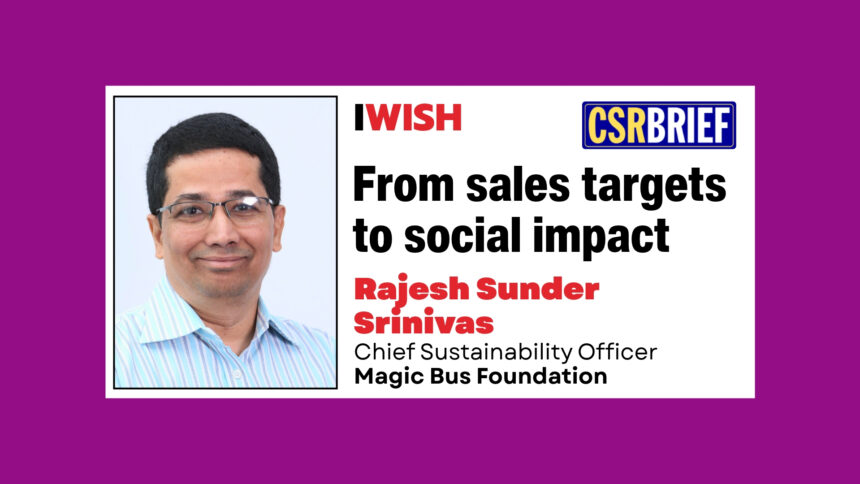
Rajesh Sunder Srinivas, Chief Sustainability Officer, Magic Bus India Foundation, writes on invitation for I Wish from CSRBrief. Founded in 1999 by Matthew Spacie, Magic Bus India Foundation uses sport and activity-based learning to build life skills in young people, with the aim of taking them from childhood to livelihood and out of poverty. The organisation says it has reached more than five million young people from underserved communities. Here, Rajesh looks back on eight years in the social sector after a corporate career in sales.
I Wish: By Rajesh Sunder Srinivas, Chief Sustainability Officer, Magic Bus India Foundation
From sales targets to social impact: Eight years on the side of real impact
Eight years in the social sector have taught me that the skills we build in the corporate world can find a new purpose in creating meaningful change.
 This November marks eight years since I walked out of the corporate world and into the social sector.
I wish I could say I made the move with a grand plan. The truth is, I arrived with more curiosity than conviction and a limited understanding of how the sector worked. I wanted to understand what inspires people to dedicate their lives to improving the lives of others and whether my own professional experience could contribute meaningfully to that mission.
Eight years later, I have a clearer answer. But the journey required me to unlearn assumptions, look beyond spreadsheets and understand what creating change really means on the ground.
Learning beyond the numbers
My first year was less about doing and more about observing and introspection. Like many professionals transitioning from the corporate world, I came with established ideas about how schools should function and how young people should be skilled. The field quickly challenged them.
At the time, CSR in India was becoming more structured, with companies increasingly focused on measurable outcomes and accountability. I found myself at the intersection of two worlds: one accustomed to targets and quarterly reviews, and another navigating the complexities of social change.
During field visits, we encountered questions that no spreadsheet could fully answer. Why was attendance difficult to capture consistently? What prevented a programme from being implemented as planned? How could we explain these realities to donors expecting clear numbers every quarter?
But what stayed with me most was not the complexity of implementation. It was the people.
The dedication of frontline workers was remarkable. Many came from the same communities they served. They understood local challenges, had already built trust and worked patiently with children, parents and families to create opportunities for change.
I came to believe that the social sector stands on the shoulders of these individuals. Their stories showed me that impact is not just about meeting targets; it is about helping people move forward in ways that matter to them.
Finding familiar skills in an unfamiliar sector
Whenever I meet friends from the corporate world, they ask me, “So, how was the switch?”
My answer often surprises them: the transition was smoother than they might expect. Given my background in sales, fundraising was a natural fit.
I discovered that many principles remain the same across sectors. Relationships matter. Trust matters. Understanding the other person’s priorities matters.
I realised that my corporate experience had not become irrelevant; it had found a new purpose
My experience managing complex corporate accounts had taught me to listen carefully, understand stakeholder expectations and build relationships over time. These skills proved invaluable when engaging with donors and helping them understand what programmes could realistically achieve.
Fundraising also meant bridging two perspectives. Donors needed clarity on outcomes and the utilisation of funds, while programme teams had to navigate the realities of implementation and community needs.
My role often became that of a translator between two worlds that wanted the same thing but spoke different languages. I realised that my corporate experience had not become irrelevant; it had found a new purpose.
When impact comes full circle
A few years into my journey, I helped secure a grant for a project in my birth district. About a year later, I returned to visit the schools in that village.
Children who had previously had little access to educational technology were now using digital content to understand their lessons. The headmaster told me that the school’s academic scores had improved significantly.
Standing in that classroom, I experienced a sense of fulfilment unlike anything a sales target had given me. I could see how support had translated into a different learning experience for children in a place that was deeply personal to me.
Over the years, other stories have stayed with me: young people becoming the first salaried earners in their families, and women building enterprises that help them support their households and invest in their children’s education.
These experiences reinforced an important lesson: meaningful impact rarely comes from one intervention alone. It grows through the collective efforts of communities, frontline workers, programme teams and donors who remain committed to a shared goal.
Taking your skills beyond the boardroom
Looking back, the biggest lesson from these eight years is that moving into the social sector does not mean starting from scratch. It means learning to apply what you already know in a different context.
The sector needs professionals who can manage finances, use technology, strengthen compliance, improve operational efficiency, build partnerships and develop sustainable funding models.
Not everyone needs to make a complete career switch, as I did. You can contribute by volunteering your expertise, mentoring young people, supporting nonprofit operations or helping organisations build partnerships.
I wish more professionals knew that moving into the social sector does not mean starting from scratch
As I approach eight years on the other side, I realise that the corporate world taught me how to build relationships and deliver results, while the social sector taught me to look more closely at what those results mean for people.
You do not have to change your entire career to make a difference. Sometimes, you simply have to change the way you use what you already know.
About Rajesh Sunder Srinivas
Rajesh is Chief Sustainability Officer at Magic Bus India Foundation, where he leads the organisation’s CSR fundraising, donor partner retention, and individual fundraising efforts. His focus is on building sustainable funding streams and strengthening donor partnerships to amplify Magic Bus’s long-term impact.
Across three decades of experience, Rajesh has successfully navigated both the corporate and social sectors, bringing a unique blend of strategic vision, fundraising expertise, and relationship management.
Rajesh is in his second tenure at Magic Bus India Foundation, where he previously played a key role in building and strengthening corporate alliances. Prior to rejoining Magic Bus, Rajesh served as Chief Resource Officer at Smile Foundation, New Delhi.
Before transitioning to the social sector, Rajesh built a distinguished career in the corporate world, holding senior leadership roles at global IT multinationals such as Oracle, Novell (now OpenText), and TechPacific (now Ingram Micro). His expertise in direct sales, partner and distributor management, alliances, and business development provided him with a strong foundation in strategic growth and relationship management.