



Reliance Foundation was established in 2010 under its Founder and Chairperson, Nita M Ambani, to give greater impetus to the philanthropic work of Reliance Industries Limited. What began with programmes in rural transformation, education and community support has since become a large social-development platform working across very different areas of need: rural transformation, health, education, sport for development, disaster management, women’s empowerment, arts, culture and heritage, environment and animal welfare, and urban renewal. The Foundation works through its own programmes and institutions, through partnerships with governments, civil-society organisations and specialist collaborators, and, when required, with capabilities drawn from the wider Reliance group.
- How Reliance Foundation took shape: From rural transformation to a national platform
- Rural transformation: What an Observer Research Foundation study of 2,141 households found
- COVID-19 and disaster response: 8.5 crore meals and more than 66 disasters
- Healthcare: From doorstep outreach to a 345-bed hospital in Mumbai
- Education: From Education for All to 50,000 Reliance Foundation Scholarships
- Sport for development: 2.3 crore young people and more than 200 athletes
- Women’s empowerment: Swayamshree and 15.72 lakh women and girls
- Arts, environment and urban renewal: Widening the definition of impact
- ₹2,248 crore and ₹1,223 crore: What the Reliance CSR numbers actually measure
- From a foundation to a national platform: The power of continuity
- What makes the Reliance Foundation model distinctive: Six features
- Lessons for corporate India from the Reliance Foundation journey
- CSRBrief View – Why this matters: Scale that can move across needs
- Reliance Foundation at a glance
- Reliance Foundation: Key milestones, 2010 to 2026
- Editor’s note
- About Beyond CSR
Its reported reach has grown steadily: more than 10 lakh people by 2012-13, 50 lakh by 2014-15, 1.2 crore by 2016-17, 2 crore by 2017-18, 2.6 crore by 2018-19, 3.6 crore by 2019-20, 5.1 crore in the pandemic year of 2020-21, 5.75 crore by 2021-22, 6.95 crore by 2022-23, 7.6 crore by 2023-24 and more than 8.7 crore by 2024-25.

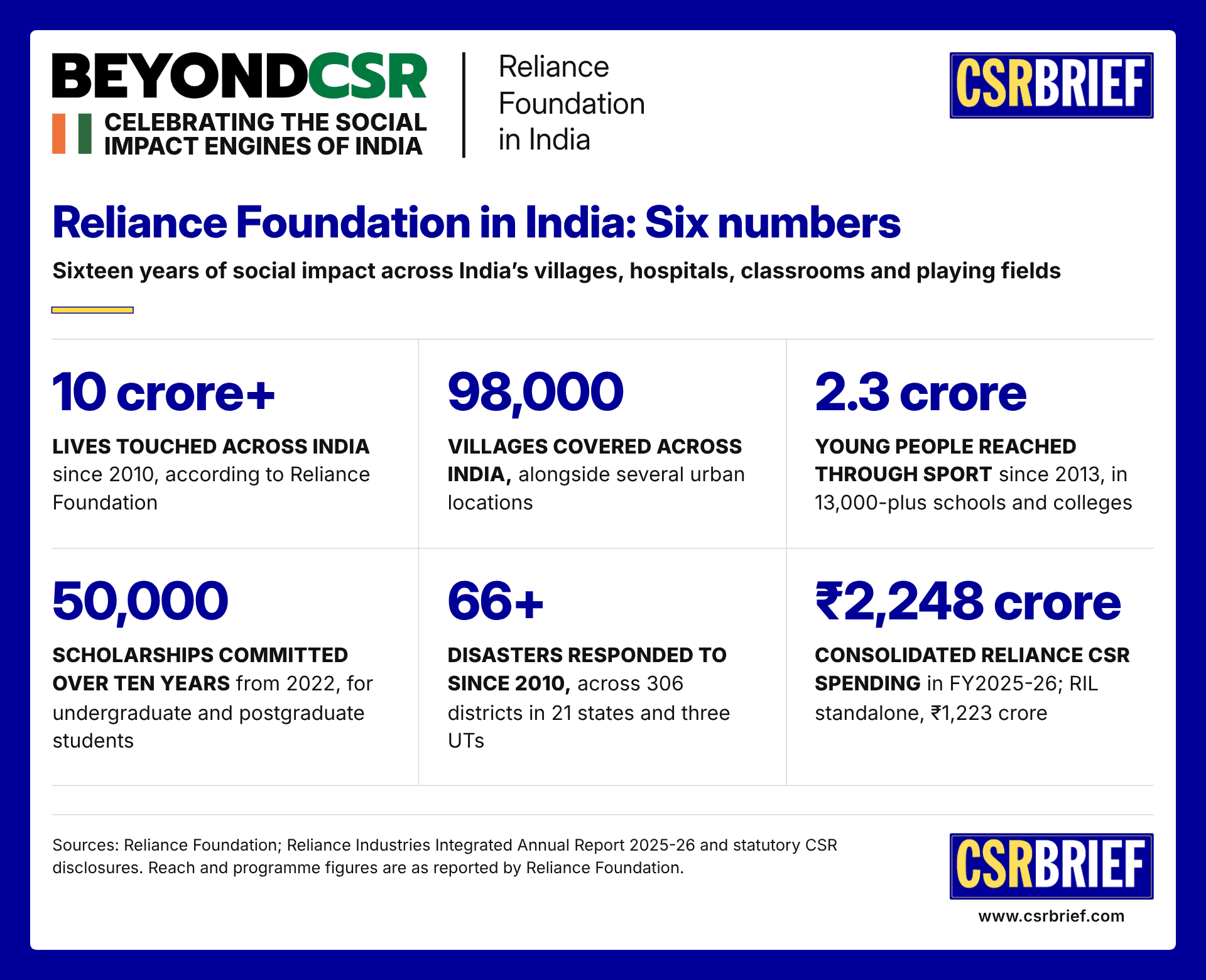
Reliance Industries’ FY2025-26 Integrated Annual Report put the Foundation’s cumulative reach at more than 9.7 crore people at the end of that financial year, and the Foundation’s current reporting says its work has now touched more than 10 crore lives and covered 98,000 villages across India. Behind those numbers is a range of capabilities: rural development, primary and advanced healthcare, school and university education, grassroots and elite sport, women’s economic empowerment, disaster response, culture, wildlife care and public spaces each need different programmes and expertise. The Foundation’s growth is less the story of one programme becoming larger than of several distinct social-impact engines being built within one institution.
How Reliance Foundation took shape: From rural transformation to a national platform
2010-14: Rural transformation, education and the first sports platform
The first phase, in 2010-12, saw the establishment of Reliance Foundation, the Reliance Foundation Bharat India Jodo initiative and Education for All, which sought to widen educational opportunities for children from underserved communities. Rural transformation was present from the beginning and remains one of the Foundation’s longest-running areas of work.
By 2012-13, the Foundation reported reaching more than 10 lakh people across 2,500 villages in 10 states and one Union Territory. That year it launched Reliance Foundation Information Services, to give rural communities better access to useful information, and a Health Outreach Programme in Mumbai through mobile and static medical units. Reliance Foundation Drishti, which included a Hindi Braille newspaper, added work on accessibility and inclusion.
Reach rose to 40 lakh people in 2013-14, when sport arrived as a vehicle for development through the Reliance Foundation Junior NBA programme, run with the National Basketball Association to bring organised basketball to young people at scale. By 2014-15, the Foundation reported reaching more than 50 lakh people across 5,500 villages in 12 states and one Union Territory.
2014-17: A hospital, Project ASMAN and grassroots sport scale up
The year 2014-15 brought two institutional milestones: the Sir H N Reliance Foundation Hospital and Research Centre opened in Mumbai as a 345-bed multi-speciality hospital, and Reliance Foundation Young Champs was launched as a full-time residential football scholarship and development programme. The following year, the Foundation reported reaching 60 lakh people across 10,500 villages and 50 urban locations, and joined Project ASMAN, a collaboration with the Bill & Melinda Gates Foundation, USAID, Tata Trusts and MSD for Mothers to reduce maternal and neonatal mortality. Scholarships, school interventions and community education continued alongside.
By 2016-17, reported reach had doubled to 1.2 crore people across more than 12,500 villages and 74 urban locations. Reliance Foundation Youth Sports was launched as a national grassroots platform and, according to the Foundation, reached 20 lakh children in its first year. A Digital Learning Van was introduced in Maharashtra, and cultural support included commissioning 17,000 Pichvai paintings from 100 artists in Nathdwara. Rural communities, students, patients, athletes and artisans were very different constituencies, but all were becoming part of the same platform.
2017-20: Water, sanitation and a widening national footprint
By 2017-18, the Foundation reported reaching 2 crore people across 13,500 villages and 100 urban locations. Its work with the Swachh Bharat Mission included building more than 15,000 toilets, with 87 project villages reported as open-defecation-free. A renewed partnership with Maharashtra’s Women and Child Development Department focused on child nutrition through anganwadis, and Reliance Foundation Young Champs received four-star accreditation from the All India Football Federation.
By 2018-19, reach had risen to 2.6 crore people across 18,000 villages and 200 urban locations, and the Foundation reported creating 86 billion litres of water-harvesting capacity, improving water security in 434 villages. The first Reliance Foundation Teacher Awards recognised 1,000 teachers, Education for All evolved into Education and Sports for All, and a partnership with the Odisha government set up an Athletics High Performance Centre in Bhubaneswar.
The footprint crossed 3.6 crore people in 2019-20, across 37,000 villages and urban locations. A water-conservation campaign under the Jal Shakti Abhiyan reached more than 10 lakh people, and the Recycle4Life campaign collected 78 tonnes of single-use plastic with the help of three lakh volunteers.
Rural transformation: What an Observer Research Foundation study of 2,141 households found
Rural transformation is one of the longest continuous threads in the Foundation’s work. A study developed by Reliance Foundation with the Observer Research Foundation followed one core programme from its start in 2010-11 across 560 villages to work that later expanded to nearly 3,000 villages in several states. The programme focused on water security, agricultural productivity, farmer collectives, local institutions and convergence with government and gram panchayats.
The study examined more than a decade of work in four clusters, Balangir in Odisha, Mandla in Madhya Pradesh, Adoni in Andhra Pradesh and Radhanpur in Gujarat, and its analysis covered 2,141 households. It found substantial though uneven gains in well-being, resilience and poverty reduction, and associated work on water security, land development, nutrition, women’s self-help groups, village institutions and farmer organisations with better livelihoods, consumption and agency. It also identified where progress was weaker: Radhanpur showed mixed outcomes, and poorer households, landless families, women-headed households and migration-dependent groups were not reached equally.
That makes the study useful. It examines not only the programme’s scale but what more than a decade of work appears to have changed and where challenges remain, and it shows national reach sitting alongside programmes that stay in particular places long enough for change to be measured.
COVID-19 and disaster response: 8.5 crore meals and more than 66 disasters
The COVID-19 pandemic was one of the biggest tests of the Foundation’s ability to mobilise at scale. By FY2020-21, it reported reaching 5.1 crore people across more than 44,700 villages through its development work. During the pandemic, Mission Anna Seva distributed 8.5 crore meals, according to Reliance, and Reliance says its Jamnagar facility supplied 11% of India’s total production of medical-grade liquid oxygen during a critical phase, enough for around one lakh patients a day. The Foundation’s reporting also records 1.4 crore masks distributed across 26 states and Union Territories, and Reliance provided 27 lakh litres of free fuel to more than 70,000 notified emergency vehicles.
Food, medical oxygen, masks, emergency transport and community outreach each needed different resources, logistics and networks, and the Foundation could draw on the wider infrastructure and operations of Reliance as well as its own programmes. That wider group remains visible in disaster response. Reliance Foundation says that since 2010 it has responded to more than 66 disasters across 306 districts in 21 states and three Union Territories, reaching more than two crore people and supporting nearly one lakh livestock, with more than 5,000 volunteers from Reliance Industries, Reliance Retail, Reliance Jio, Vantara and other group companies.
The work has covered floods, cyclones, earthquakes and the pandemic. Beyond immediate relief, the Foundation describes its disaster-management work as strengthening preparedness and resilience in vulnerable communities, and a major disaster can call on communications, logistics, retail supply chains, fuel, volunteers, animal care and community networks at the same time.
Healthcare: From doorstep outreach to a 345-bed hospital in Mumbai
Healthcare runs at very different levels within the Foundation. At one end is the Sir H N Reliance Foundation Hospital and Research Centre in Mumbai, opened in 2014 as a multi-speciality institution providing advanced care. At the other is a large community outreach network of mobile medical units, static units, community health centres, screening and health camps. Across its Health Outreach programmes, Reliance reports around 94 lakh consultations since inception.
Within that portfolio, the Sir H N Reliance Health Outreach Programme, which began in 2012, has delivered more than eight lakh consultations through community-based preventive and primary care, using screening, referral and follow-up to reach underserved urban and rural populations. In FY2024-25 alone, it reported more than 2.575 lakh free consultations, more than 50,000 new families enrolled and more than 1.2 lakh people screened, including more than 50,000 women screened for anaemia and over 10,495 children under five screened for malnutrition. It reported a further 2.073 lakh-plus free consultations between April and December 2025.
The work has also deepened around early detection. The Health Seva Plan, launched in October 2024, has included breast and cervical cancer screening for women, HPV vaccination for adolescent girls, cardiac screening for children and support for children who need life-saving cardiac surgery.
Education: From Education for All to 50,000 Reliance Foundation Scholarships
Education has been part of the Foundation from its first years. Education for All, launched in 2010-12, later became Education and Sports for All, and the Foundation has continued to support schools, teachers, digital learning and higher education. Scholarships are now the largest identifiable part of the higher-education effort.
In 2022, Reliance Foundation committed to supporting 50,000 undergraduate and postgraduate students through scholarships over ten years. Each annual cohort includes 5,000 merit-cum-means undergraduate scholars, who can receive up to ₹2 lakh, and 100 postgraduate scholars in selected future-facing disciplines, who can receive up to ₹6 lakh. By August 2026, Reliance said it had awarded more than 33,000 scholarships across its longer scholarship journey, and applications had opened for another 5,100 for 2026-27.
The Foundation’s latest disclosure says the previous cohort of 5,100 scholars came from 1,350 institutions across 27 states and seven Union Territories. The programme combines financial support with mentoring, professional development and a scholar community, and the ten-year commitment turns it from an annual awards exercise into a continuing pipeline into higher education.
Sport for development: 2.3 crore young people and more than 200 athletes
Sport is one of the areas that most clearly sets the Foundation’s portfolio apart. Its sports initiatives have reached more than 2.3 crore young people since 2013, across more than 13,000 schools and colleges, through grassroots participation, school and college competitions, football development, athlete scholarships, sports science, high-performance training and partnerships with sporting bodies.
Reliance Foundation Youth Sports reached 20 lakh children in its first year, 2016-17. Reliance Foundation Young Champs created a residential football pathway, and later programmes expanded into athletics and the wider Olympic movement. The Foundation now supports more than 200 athletes across more than 10 Olympic sports, runs three high-performance athletics training facilities and lists the International Olympic Committee, the Indian Olympic Association, the Athletics Federation of India and the Government of Odisha among its partners. The same platform works at both ends: millions of children are encouraged to play, and talented athletes receive specialist support towards elite competition.
Women’s empowerment: Swayamshree and 15.72 lakh women and girls
Women have been part of the Foundation’s rural, health, education and sport programmes from the beginning, but women’s empowerment has increasingly become a defined area of work in its own right. The Foundation reports more than 15.72 lakh women and girls impacted, through work on livelihoods, digital inclusion, health, education, sport, leadership and access to social-security entitlements.
One of its largest initiatives is Swayamshree, launched in 2023 with the Gates Foundation, which aims to empower 10 lakh women across Madhya Pradesh, Gujarat and Odisha with State Rural Livelihood Missions and grassroots partners. It focuses on women-led livelihoods and on helping households reach annual incomes of at least ₹1 lakh, working through self-help groups, producer collectives and federations across farm and non-farm value chains. By September 2025, the Foundation said Swayamshree had worked with more than 3.8 lakh women in Madhya Pradesh alone.
Digital inclusion has developed alongside. The WomenConnect Challenge India supported organisations working on women’s access to and use of technology, and on 13 April 2026, Reliance Foundation and C-DAC Hyderabad launched e-SafeHER, a cyber-security awareness programme that aims to reach one million rural women over three years.
Arts, environment and urban renewal: Widening the definition of impact
Arts, culture and heritage: Preserving skills and tradition
The Foundation has supported Indian arts, crafts and cultural traditions, including Pichvai artists in Rajasthan, and later developed Swadesh as a platform supporting and showcasing Indian crafts and heritage. Arts, culture and heritage is now a separate area of its work, aimed at sustaining skills, traditions and cultural knowledge that can become vulnerable as markets, lifestyles and communities change.
Environment, animal welfare and urban renewal
Environment and animal welfare have become more prominent too. Plant4Life was launched as a community-driven environmental initiative, and Vantara as a large wildlife rescue, treatment, rehabilitation and conservation initiative, and environment and animal welfare is now one of the Foundation’s principal areas of work. Urban renewal, aimed at creating and improving public spaces and urban infrastructure, is another. These additions show how far the Foundation’s definition of social responsibility has widened since 2010.
₹2,248 crore and ₹1,223 crore: What the Reliance CSR numbers actually measure
The money behind Reliance’s social investment is substantial, but two different measures need to be kept apart. At group level, Reliance’s consolidated financial statements record CSR expenditure of ₹2,248 crore in FY2025-26, against ₹2,156 crore in FY2024-25. Separately, Reliance Industries Limited’s standalone statutory disclosure records CSR expenditure of ₹1,223 crore under Section 135 of the Companies Act, against an obligation of ₹1,032 crore, an excess of ₹191 crore.
The ₹2,248 crore is a consolidated group figure; the ₹1,223 crore is Reliance Industries’ own statutory spending. Neither should be combined with the other or presented as Reliance Foundation’s standalone expenditure, and the Foundation’s reach and programme figures are a separate part of the picture. Attaching group-level spending directly to the Foundation would overstate or misdescribe the scale of its work.
From a foundation to a national platform: The power of continuity
The progression since 2010 shows in both reach and structure. The Foundation began with rural transformation and education; health outreach followed, and then a major hospital. Sport grew from school programmes into national competitions, residential talent development and support for elite athletes. Disaster management acquired a national response network, scholarships expanded, women’s empowerment gained dedicated programmes, and environment, animal welfare, culture and urban public spaces widened the idea of social impact further.
The Foundation has also developed different ways of working. Some programmes are run directly; others depend on NGOs and community institutions, or are built with state and central agencies, international organisations, sporting bodies, universities and specialist partners. During disasters, the group’s logistics, technology, workforce and operations can become part of the response. Its scale comes not from repeating one model across the country but from running several operating models within one institution and using each where it fits.
Why continuity matters as much as scale
Scale attracts attention, but continuity may matter as much. The rural-transformation study shows what becomes possible when work lasts long enough to be studied over a decade. Health outreach that began in 2012 has grown into a system of primary care, screening, referral and specialised initiatives; sport has moved from grassroots participation into talent pathways; and scholarships have become a ten-year commitment. An institution already working across communities also has the relationships, people and systems to redirect when an emergency arrives. Continuity here does not mean doing the same thing: the portfolio today looks very different from 2010, but the institutional platform has stayed constant.
What makes the Reliance Foundation model distinctive: Six features
The first is scale: the Foundation reports that its work has touched more than 10 crore lives across 98,000 villages. The second is breadth, since rural transformation, healthcare, education, sport, women’s empowerment, disaster response, culture, environment, animal welfare and urban renewal each need different expertise and operating models. The third is the ability to work at very different levels, from long-term work with village institutions to a multi-speciality hospital, and from a child’s first organised competition to sports-science support for an Olympic athlete or a ten-year scholarship commitment.
The fourth is partnership, with governments, civil-society organisations, international development partners, sporting bodies, educational institutions and specialist organisations. The fifth is the ability to draw on the wider Reliance group, most visible in disaster response and the COVID-19 emergency, when logistics, production capability, fuel and employees were mobilised behind a social need. The sixth is sustained expansion: from 10 lakh people reached in 2012-13 to more than 10 crore today, with the number and nature of programme areas growing over the same period.
Lessons for corporate India from the Reliance Foundation journey
The first lesson is that scale does not require a foundation to work on only one problem, but breadth requires operating capability. Rural development, healthcare, sport and disaster response need different expertise, partners and measures of success, and a large platform has to allow for those differences rather than force every intervention into one model.
The second is the value of letting programmes mature. The rural-transformation work now has more than a decade of evidence from its earliest clusters, health outreach has grown into screening, referral and specialised care, grassroots sport now reaches into Olympic pathways, and scholarships have become a ten-year commitment.
The third is that a company’s wider strengths can be put behind social need. Few foundations will have capabilities on the scale Reliance mobilised during the pandemic, but the principle travels: social responsibility can draw intelligently on what an organisation knows, owns and does well.
CSRBrief View – Why this matters: Scale that can move across needs
Reliance Foundation’s significance lies in the breadth of its work as much as its reported reach of more than 10 crore lives. In 16 years it has built separate capabilities for rural livelihoods, healthcare, scholarships, sport, women’s enterprise and disaster response, and has shown that one institution can run them side by side without forcing them into a single model.
The Foundation’s own commissioned research, notably the Observer Research Foundation study, also records where progress has been uneven, which is the kind of evidence that helps the wider sector learn. For companies with large CSR budgets, Reliance Foundation is a useful example of how sustained investment, partnerships and a willingness to keep adding new areas of work can build a national social-impact platform, and that deserves recognition.
Reliance Foundation at a glance
- Established: 2010
- Founder and Chairperson: Nita M Ambani
- Current reported reach: More than 10 crore lives
- Current reported village coverage: 98,000 villages
- FY2025-26 year-end reach reported in Reliance Industries’ Integrated Annual Report: More than 9.7 crore people
- Current areas of work: Rural Transformation; Health; Education; Sports for Development; Disaster Management; Women Empowerment; Arts, Culture & Heritage; Environment & Animal Welfare; Urban Renewal
- Rural-transformation study: 2,141 households across four clusters, examining a programme that began across 560 villages and later expanded to nearly 3,000
- Wider Health Outreach consultations reported since inception: Around 94 lakh
- Sir H N Reliance Health Outreach Programme consultations: More than eight lakh
- Sports reach: More than 2.3 crore young people across 13,000-plus schools and colleges
- Athletes supported: More than 200 across more than 10 Olympic sports
- Disaster response: More than 66 disasters across 306 districts in 21 states and three Union Territories
- People reached through disaster response: More than two crore
- Reliance volunteers involved in disaster response: More than 5,000
- Women and girls impacted across programmes: More than 15.72 lakh
- Scholarship commitment: 50,000 undergraduate and postgraduate scholarships over ten years
- Current scholarship structure: 5,000 undergraduate and 100 postgraduate scholars annually
- Consolidated Reliance CSR expenditure, FY2025-26: ₹2,248 crore
- RIL standalone statutory CSR expenditure, FY2025-26: ₹1,223 crore against an obligation of ₹1,032 crore
Reliance Foundation: Key milestones, 2010 to 2026

- 2010-12: Reliance Foundation is established; Bharat India Jodo and Education for All begin.
- 2012-13: Reported reach crosses 10 lakh people across 2,500 villages; Information Services, Health Outreach and Drishti develop.
- 2013-14: Reach rises to 40 lakh; Junior NBA strengthens sport as a development platform.
- 2014-15: Reported reach crosses 50 lakh; Sir H N Reliance Foundation Hospital and Reliance Foundation Young Champs are launched.
- 2015-16: Reported reach rises to 60 lakh; Reliance Foundation participates in Project ASMAN.
- 2016-17: Reach crosses 1.2 crore; Reliance Foundation Youth Sports launches and reaches 20 lakh children in its first year.
- 2017-18: Reach crosses 2 crore; sanitation and child-nutrition programmes expand.
- 2018-19: Reach reaches 2.6 crore; 86 billion litres of water-harvesting capacity is reported; Teacher Awards and the Odisha Athletics High Performance Centre are added.
- 2019-20: Reach crosses 3.6 crore; Jal Shakti and Recycle4Life campaigns expand water and environmental action.
- 2020-21: Reach crosses 5.1 crore amid the COVID-19 response; Mission Anna Seva distributes 8.5 crore meals; Reliance supplies 11% of India’s medical-grade liquid oxygen production during a critical period.
- 2021-22: Reported reach rises to 5.75 crore.
- 2022-23: Reported reach rises to 6.95 crore; the ten-year commitment to 50,000 Reliance Foundation Scholarships is announced.
- 2023-24: Reported reach reaches 7.6 crore; Swayamshree, Plant4Life and newer environmental and animal-welfare initiatives deepen the portfolio.
- 2024-25: Reliance Foundation reports cumulative reach above 8.7 crore.
- FY2025-26: Reliance Industries’ Integrated Annual Report records Reliance Foundation’s cumulative reach above 9.7 crore.
- 2026: Reliance Foundation’s updated reporting puts its cumulative efforts above 10 crore lives and 98,000 villages.
- 2026: Applications open for another 5,100 Reliance Foundation Scholarships for 2026-27.
- 2026: e-SafeHER launches with C-DAC Hyderabad with the aim of reaching one million rural women over three years.
Editor’s note
This DeepDive has been developed through detailed research based on publicly available information, including Reliance Foundation and Reliance Industries’ official reports and disclosures, programme material, impact studies, institutional records and other credible sources. It is intended as a considered look at the social responsibility and impact created through Reliance Foundation, and at how its work has developed since 2010 into a wide-ranging national social-impact platform.
We have made every effort to verify facts, dates, figures and programme details, but we regret any inadvertent error or omission. CSRBrief would be happy to receive any factual clarification or correction. Please email us, and we will review and correct where warranted. Substantive corrections carry a dated note on the story.
About Beyond CSR
Beyond CSR is a CSRBrief editorial franchise examining the most significant CSR engines shaping social impact in India: companies, foundations and flagship programmes worth understanding because of their scale, longevity, innovation, institutional depth, replicability and impact.
It is not a ranking by CSR expenditure. Each DeepDive examines what was built, how the model developed, what kind of impact it created, what has endured, how it continues to evolve and what others can learn from it.
We hope that for everyone interested in and working with CSR, Beyond CSR becomes much more valuable than a conventional ‘Top CSR companies’ list.