

In June 2025, on a site in Visakhapatnam, ICICI Bank and Tata Memorial Centre laid the foundation stone for an eight-storey building for children with cancer and patients with blood cancers. The ICICI Foundation Block for Child and Blood Cancer is planned with more than 215 beds and capacity for around 3,000 patients a year. It will cost ₹550 crore. ICICI Bank’s Chairman, Pradeep Kumar Sinha, described it as one of the largest such projects in India’s eastern corridor.
- Before the Foundation: ICICI’s 1955 beginnings as a builder of Indian industry
- 2007: Nachiket Mor and a plan to make markets work for the poor
- 2011 to 2015: Teachers, a national health pilot and the ICICI Academy for Skills
- From villages to oxygen concentrators: The Foundation’s widening reach, 2016 to 2021
- ₹1,800 crore for Tata Memorial Centre: ICICI’s signature cancer-care commitment
- 600 hospitals and three IITs: Healthcare beyond Tata Memorial
- Industry 4.0 labs at nine NSTIs: The skills model changes shape
- 3,437 crore litres and 83 forests: Water, trees and wildlife
- Financial literacy and sport: The community programmes
- From a 2007 pledge to ₹994 crore a year: The money behind the model
- What makes the ICICI model distinctive: Institutions that outlast the cheque
- Lessons for corporate India from the ICICI journey
- CSRBrief View – Why this matters: From classrooms to cancer wards, 18 years of building what lasts
- ICICI Foundation at a glance
- ICICI Foundation: Key milestones, 1955 to 2027
- Editor’s note
- About Beyond CSR
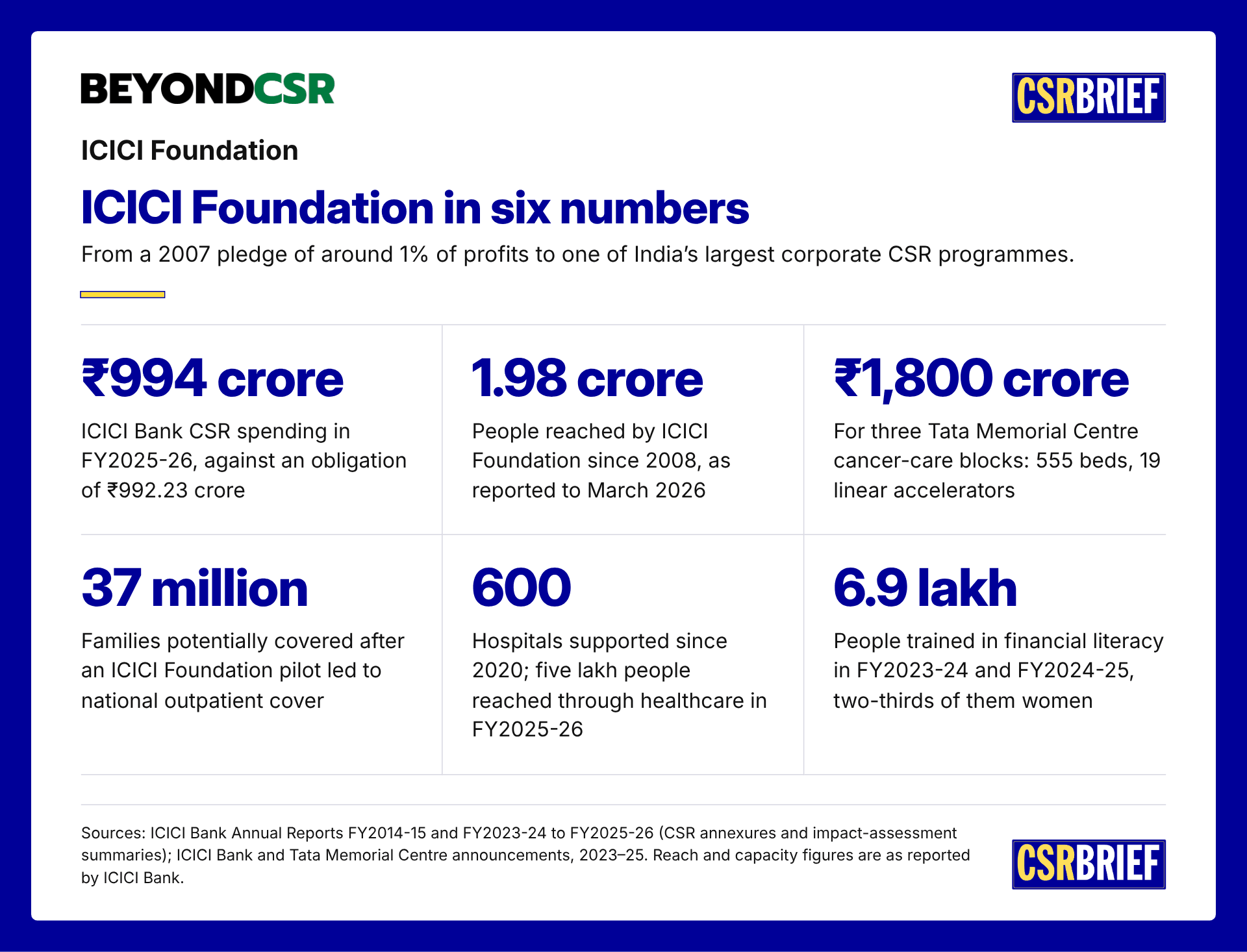
Visakhapatnam is one of three. Together with a radiation-oncology block in Navi Mumbai and a paediatric and haematological oncology block at Mullanpur, near Chandigarh, it forms a ₹1,800 crore commitment from ICICI Bank to Tata Memorial Centre — 10.7 lakh square feet, 19 linear accelerators and 555 beds across the three sites, with ICICI Foundation overseeing implementation. It ranks among the largest single CSR commitments to healthcare in India.
The more interesting question is how a bank came to be building cancer wards at all.
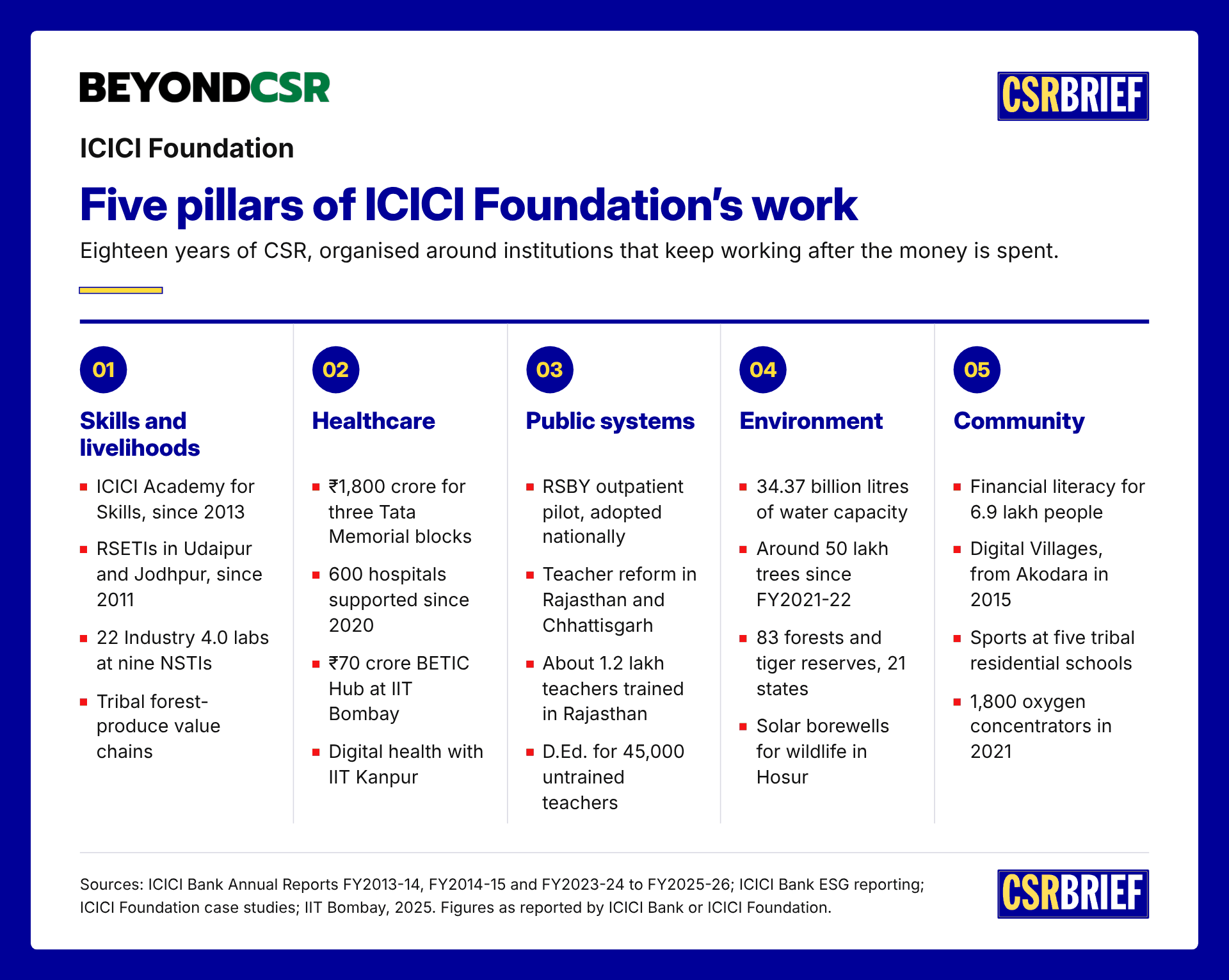
The answer runs back through seven decades: to a development financial institution set up in 1955 to finance Indian industry; to a senior banker who walked away from the deputy managing director’s office in 2007 to run a foundation with almost no staff and a mission to “make the markets work for the poor”; and to an organisation that has since retrained teachers, helped turn a health pilot in two districts into a national benefit, run rural training institutes, built a national skills academy, supplied oxygen concentrators to the Himalayas during the pandemic and, now, equipped laboratories at three IITs.
ICICI Bank reports that, by 31 March 2026, the Foundation’s work had reached 1.983 crore people across India.
Before the Foundation: ICICI’s 1955 beginnings as a builder of Indian industry
The Industrial Credit and Investment Corporation of India was formed in 1955 at the initiative of the World Bank, the Government of India and representatives of Indian industry. Its job was to provide medium- and long-term project finance to Indian businesses at a time when such capital was scarce. ICICI Bank was incorporated in 1994 as part of the group, and in 2002 the parent institution merged into the Bank.
Industrial finance is not CSR, and this DeepDive does not count it as such. But the lineage matters for one reason: ICICI was created to build capacity — to fund the plant, the machinery and the institution that would go on producing long after the cheque cleared. That instinct reappears, almost unchanged, in what its Foundation chose to build half a century later.
The Group’s links with social institutions also predate the Foundation. Pratham, the education organisation, records that Narayanan Vaghul, then ICICI’s Chairman, became one of its trustees in 1996.
2007: Nachiket Mor and a plan to make markets work for the poor
The Foundation’s founding figure was Nachiket Mor, who had joined ICICI in 1987 and risen to Deputy Managing Director of ICICI Bank. Mor had led the ICICI Group’s social initiatives for several years and had driven the Bank’s rural-banking strategy from 2003. With effect from 22 October 2007, the Bank announced, he would step away from the Bank to lead the new ICICI Foundation for Inclusive Growth, which would “integrate, consolidate and scale up the ICICI Group’s existing initiatives”.
The funding commitment was what set it apart. Each year, the ICICI Group would contribute around one per cent of its published profit after tax for the preceding year as a grant to the Foundation’s corpus. That was in 2007. The Companies Act, 2013, which made CSR spending mandatory for large companies, was still six years away, and its two per cent rule would not take effect until 2014.
Mor’s idea of the Foundation was not charity in the conventional sense. “The idea is to make the markets work for the poor,” he told Business Today in December 2007. The early plan was to catalyse specialised institutions linked to both communities and wider markets — in microfinance, insurance and credit history — and to work through partners such as IFMR Trust and Grameen Capital India rather than build everything in-house. When the Foundation began work in early 2008, it had an initial endowment of around US$820,000 and a team that, by one contemporary account, consisted of Mor and a single vice-president.
“The idea is to make the markets work for the poor.”
— Nachiket Mor, founding head of ICICI Foundation, to Business Today, December 2007
Mor left in September 2010. He went on to serve on the Reserve Bank of India’s Central Board, to chair the RBI committee on comprehensive financial services for small businesses and low-income households, and to lead the Bill & Melinda Gates Foundation’s India office. The Foundation he set up took a different, more hands-on path after him. But the founding idea — that ICICI’s contribution should be to institutions and systems, not only to projects — never quite left it. Subrata Mukherji led the Foundation as President in the years that followed; Sanjay Datta is named as President in its 2023 and 2025 announcements.
2011 to 2015: Teachers, a national health pilot and the ICICI Academy for Skills
The years after Mor’s departure saw the Foundation move from financial-inclusion design into direct work with government systems and with young people looking for work. By 2014, the Bank described it as working on two models: “projects for systemic change where ICICI Foundation works with governments and local NGOs; and direct impact programmes”.
Rebuilding teacher education in Rajasthan and Chhattisgarh
Among the first major programmes were six-year School and Teacher Education Reform partnerships with the Government of Rajasthan, from April 2011, and the Government of Chhattisgarh, from July 2012. In Rajasthan, the Foundation worked with the State Institute of Educational Research and Training to revise the curricula and syllabi for Classes I to VIII, and 24 new textbooks were developed. By March 2014, the Bank reported, 310 key resource persons had trained more than 2,000 master trainers, who in turn trained about 1.2 lakh serving government teachers in the new curriculum. In Chhattisgarh, working with the State Council of Educational Research and Training, the Foundation helped develop a two-year open and distance Diploma in Education for 45,000 untrained teachers, alongside reform of the B.Ed. syllabus and development plans for 100 demonstration schools.
This was CSR working at the level where one intervention reaches thousands of classrooms: the training of the people who teach in them.
Mehsana and Puri: A health pilot that became national policy
The Foundation’s early health work produced what may be its most far-reaching result. In 2011, with the Ministry of Labour and Employment and the International Labour Organization’s Microinsurance Innovation Facility, and with ICICI Lombard as implementation partner, it launched a pilot to add outpatient care to the Rashtriya Swasthya Bima Yojana, the national health insurance scheme for families below the poverty line, which until then covered only hospital admissions. The pilot ran in Puri, Odisha, from July 2011 and Mehsana, Gujarat, from November 2011, reaching 1,90,026 families in Puri and 76,929 in Mehsana by the time it concluded in FY2014-15.
According to ICICI Bank’s annual reports, the Central government then extended outpatient care to all RSBY-empanelled hospitals as a standard product across the country, potentially benefiting 37 million families. For a foundation then barely six years old, it was an early demonstration of the idea Mor had started with: that the most valuable thing a corporate foundation can do is test a model that a much larger system can adopt.
“Based on the pilot, the Central government extended outpatient healthcare in all RSBY empanelled hospitals as a standard product across the nation, potentially benefitting 37 million families.”
— ICICI Bank Annual Report 2014-15
RSETIs in Udaipur and Jodhpur
Since March 2011, ICICI Foundation has managed two Rural Self Employment Training Institutes for the Bank, in Udaipur and Jodhpur in Rajasthan, with a network of satellite centres around them. RSETIs are a national scheme of the Ministry of Rural Development, delivered through sponsor banks; ICICI did not invent the model, but its Foundation has run these two institutes for fifteen years. In 2014, the Ministry of Rural Development ranked the Jodhpur and Udaipur institutes first and second in their category nationally, and the Bank reported that about 70 per cent of trainees had moved into wage or self-employment.
The courses are built around local demand — appliance and mobile-phone repair, plumbing, carpentry, tailoring, dairy farming, nursery management — and combine trade training with financial literacy, enterprise development and help with credit linkage. For a trainee in rural Rajasthan, the point is a livelihood close to home rather than a certificate and a ticket to a city.
The ICICI Academy for Skills: Jaipur, 4 October 2013
The Foundation’s best-known programme began in Jaipur on 4 October 2013, when it launched the ICICI Academy for Skills. The plan at launch was eight centres and 5,000 young people trained in the first year, in trades such as electrical and home-appliance repair, refrigeration and air-conditioning, office administration and retail selling.
Two design choices stood out. The first was industry partnership. Course content, laboratories and trainer training came from knowledge partners who led their industries — as they did when the Narsobawadi centre in Maharashtra opened in December 2013: Blue Star for refrigeration and air-conditioning, Crompton Greaves for pumps and motors, Schneider Electric for electrical and home-appliance repair, Voltas for central air-conditioning, NIIT for web design, Tally for office administration, and Café Coffee Day, which offered trainees on its retail café course an appointment letter on the day they joined. The second was the removal of practical barriers to attending. Training was free, and residential centres provided accommodation, meals, uniforms and course material — recognition that a young person from a poor household often cannot afford a few weeks without earning, whatever the course fee.
The network grew quickly. The first 1,015 trainees completed their courses by March 2014, and more than 11,000 by March 2015, by which time there were 11 centres, including new ones set up with the governments of Chhattisgarh and Madhya Pradesh. A women-only centre opened in Lucknow in May 2015. By March 2021, the Bank reported 28 Academy centres across 19 states and two Union Territories.
From villages to oxygen concentrators: The Foundation’s widening reach, 2016 to 2021
In 2016, the Foundation began a rural livelihood programme that took its skills work into villages, with training tied to local occupations and to markets. By March 2021, the Bank reported nearly 3.07 lakh beneficiaries across more than 2,500 villages, 61 per cent of them women.
The Bank’s own financial-inclusion business met the Foundation’s work in the Digital Villages. The first, at Akodara in Gujarat’s Sabarkantha district, was dedicated to the nation by Prime Minister Narendra Modi on 2 January 2015; every adult in the village was given a bank account and access to cashless payments, alongside better school infrastructure and a skills centre. In 2017, the ICICI Group dedicated 100 ‘ICICI Digital Villages’, which brought together the Foundation’s vocational training with the Bank’s digital transactions, credit and market access — one of the clearest examples of the Group combining its business and its CSR in the same place. In February 2020, the Foundation signed an agreement with the Indian Council of Agricultural Research to bring research-backed knowledge on integrated farming, dairy, fisheries, horticulture and beekeeping into its farmer training.
Then came the pandemic. In 2021, the Foundation announced the donation of 1,800 oxygen concentrators to more than 700 sub-divisional hospitals across nearly 175 districts in 17 states, with a particular focus on the Himalayan belt and tribal areas. It paired the equipment with power backup and suppliers’ maintenance networks, and agreed with BPL Medical Technologies to develop an Academy module on installing and servicing oxygen concentrators. Few emergency donations in that period were designed with that much thought for what happens after the machine arrives.
₹1,800 crore for Tata Memorial Centre: ICICI’s signature cancer-care commitment
If the pandemic pushed healthcare to the centre of the Foundation’s work, the Tata Memorial Centre commitment made it the defining strand.
June 2023: Three blocks in three cities
On 5 June 2023, ICICI Bank announced a ₹1,200 crore contribution to Tata Memorial Centre for three new facilities: the ICICI Radiation Oncology Block at ACTREC in Navi Mumbai, and ICICI Paediatric and Haematological Oncology Blocks at Mullanpur in Punjab and Visakhapatnam in Andhra Pradesh. The paediatric blocks were planned to offer chemotherapy, bone-marrow transplantation, radiation therapy and CAR-T cell immunotherapy, with dedicated wards, day-care units, intensive care and advanced imaging and genetics laboratories.
The announcement estimated that the blocks would serve around 25,000 new patients a year, effectively doubling capacity at those sites. “Advanced cancer care must be delivered closer to home so that more people from the region benefit from accessing such therapies,” said Dr R A Badwe, then Director of Tata Memorial Centre. ICICI Foundation, represented at the announcement by its President, Sanjay Datta, was to implement the project.
“Advanced cancer care must be delivered closer to home so that more people from the region benefit from accessing such therapies.”
— Dr R A Badwe, then Director, Tata Memorial Centre, June 2023
Visakhapatnam and Navi Mumbai: ₹550 crore and ₹625 crore
By June 2025, when the Visakhapatnam foundation stone was laid, the overall commitment had grown to ₹1,800 crore. In October 2025, the Bank announced ₹625 crore for the Navi Mumbai radiation-oncology block at ACTREC, planned with 12 linear accelerators — one of India’s largest radiation-therapy facilities, in the Bank’s description — and capacity to give radiation treatment to 7,200 patients and consultations to 25,000 new patients each year. All three blocks are expected to be completed in 2027.
For readers of this series there is a satisfying symmetry here. Tata Memorial Hospital was founded in 1941 by the Sir Dorabji Tata Trust, and cancer care was the signature case study in our first Beyond CSR DeepDive [read the Tata Trusts DeepDive here]. Eighty-five years on, the institution the Tatas built is being extended by the CSR of another Indian financial group.
What the first results, and the delays, tell us
Alongside the new blocks, ICICI has funded equipment at Tata Memorial’s existing hospitals, and the Bank has published independent assessments of it. A new MRI machine at Tata Memorial Hospital in Mumbai, costing ₹5 crore and replacing one last upgraded in 2007, cut scan times by 25 per cent; the assessment summarised in the Bank’s FY2023-24 Board’s Report estimates that about 80,000 patients will benefit over its life. In FY2024-25, the Bank funded a ₹6.2 crore dual-energy CT simulator at the Proton Therapy Centre at ACTREC. The assessment summarised in the Bank’s FY2025-26 statutory disclosure found that it cut waiting times for treatment simulation from up to ten days to the same or next day, benefiting 1,265 patients in its first year, and reduced dose uncertainty from 5 per cent to 1 per cent — precision that matters most for children, who are the most sensitive to radiation reaching healthy tissue.
Large hospital construction also runs on its own clock, and the Bank’s statutory filings say so plainly. In FY2023-24, ₹150 crore budgeted for the TMC project went unspent while, in the Bank’s words, “detailed plans were being finalised for orderly execution”. In FY2024-25, ₹250 crore of the ₹274 crore transferred to the Unspent CSR Account was for the three cancer-care facilities, unspent “due to prolonged time taken for critical statutory approvals, which was beyond the control of the Bank”. The Bank had already updated its CSR policy in June 2024 to make it easier to take up multi-year projects. For a company used to quarterly results, building a hospital is a lesson in different timelines.
600 hospitals and three IITs: Healthcare beyond Tata Memorial
TMC is the largest piece of a much wider healthcare portfolio. ICICI Bank reports that the Foundation had supported 600 hospitals since 2020, reaching five lakh people through healthcare initiatives in FY2025-26 alone. The work spans cancer, cardiac, trauma and eye care.
With AIIMS institutions, the Foundation has supported catheterisation laboratories, trauma-care equipment and ambulances. At Sankara Nethralaya in Chennai, it renovated and expanded two floors of the Mahyco Block for glaucoma and uvea services, with projected capacity for around 1.18 lakh patients a year. Not every asset has worked perfectly. A ₹4.85 crore robotic gait-training machine for patients with lower-limb paralysis at Bhagwan Mahaveer Viklang Sahayata Samiti in Jaipur cut the number of sessions needed for recovery by 40 per cent — but the assessment also found high maintenance costs and under-utilisation, a finding the Bank chose to publish.
IIT Bombay: ₹70 crore for medical devices made in India
In July 2025, ICICI Foundation pledged ₹70 crore to expand IIT Bombay’s Biomedical Engineering and Technology Incubation Centre into the IITB-ICICI BETIC Hub, increasing its space fivefold to 19,700 square feet with facilities for product development, medical-grade manufacturing, safety testing, inspection and packaging. BETIC had already developed 43 medical devices, 23 of them taken to market by start-ups and 20 licensed to Indian companies. The hub, Pradeep Kumar Sinha said, would “facilitate the development of indigenous medical innovations ensuring affordable healthcare solutions to patients.”
“The ‘IITB-ICICI BETIC Hub’ will facilitate the development of indigenous medical innovations ensuring affordable healthcare solutions to patients.”
— Pradeep Kumar Sinha, Chairman, ICICI Bank, July 2025
IIT Kanpur and IIT Delhi: Digital health and shared research facilities
With IIT Kanpur, under an agreement signed in September 2023, the Foundation supports the ICICI Digital Health Stack, aligned with the Ayushman Bharat Digital Mission. The Foundation reports that a bed-booking, ambulance-discovery and referral system built on it was deployed across 28 districts during the Maha Kumbh in 2025. At IIT Delhi, it has supported a Bio-Incubation Facility and a Smart Manufacturing Lab, open to researchers, students, start-ups and industry.
Taken together, the three IITs show the Foundation’s healthcare work moving upstream — from equipping the hospital to supporting the people who will design the next generation of equipment.
Industry 4.0 labs at nine NSTIs: The skills model changes shape
The skilling story has changed shape too. ICICI Bank’s FY2025-26 ESG report describes a deliberate shift from direct implementation towards collaboration with academic and research institutions, with around 84,000 people benefiting through associations with almost 50 institutes during the year.
The clearest example is the government’s National Skill Training Institutes, where the Foundation has set up 22 Industry 4.0 laboratories across nine NSTIs, in fields including electric vehicles, artificial intelligence, robotics, semiconductors and renewable energy, along with trainer development. A laboratory inside a national institute serves batch after batch of trainees, long after a direct training programme would have ended.
In forest-dwelling communities, a partnership with the Entrepreneurship Development Institute of India works on 17 kinds of non-timber forest produce across Madhya Pradesh, Chhattisgarh, Gujarat and Maharashtra, with processing units in 14 districts and more than 2,000 tribal participants. The aim is to help producers keep more of the value of what they gather, through aggregation, processing and better market links. In all, the Bank reports 3.54 lakh people reached through skilling and livelihood work in FY2025-26.
What the Academy assessment found
The Academy has also been tested from the outside. An external assessment summarised in ICICI Bank’s FY2024-25 Board’s Report covered the Bank’s ₹28.88 crore contribution between FY2021-22 and FY2024-25, when the Academy trained 72,613 people in 15 courses across 20 states and Union Territories. Among those surveyed, 70 per cent had obtained jobs through the Academy’s placement assistance, and the assessment recorded a notable improvement in earnings after training; 85 per cent named personal development and confidence as the biggest gain. But only about 44 per cent were still in their Academy-facilitated jobs, with job-role fit, salary levels, workplace satisfaction and career progression cited as the reasons for moving on, and the assessment called for better job matching, employer partnerships and follow-up support.
“The assessment highlighted gaps in the employment ecosystem post-training and the need for better job matching, employer partnerships, and follow-up support.”
— External impact assessment of the ICICI Academy for Skills, ICICI Bank Annual Report 2024-25
Leaving a first job is not the same as unemployment. But the finding is a useful reminder that placement is where a skilling programme’s results begin, not where they end — and it is to ICICI’s credit that it was published.
3,437 crore litres and 83 forests: Water, trees and wildlife
The Foundation’s environmental work is reported at striking scale. ICICI Bank’s current ESG reporting records 34.37 billion litres — 3,437 crore litres — of water recharge and storage capacity created, around 50 lakh trees planted since FY2021-22, and conservation work across 83 forests and tiger reserves in 21 states.
The numbers become real at ground level. At Alkoda in Karnataka’s Raichur district, the Foundation restored a 100-acre lake through desilting, weed removal and associated works; it reports benefits for more than 650 households across 15 villages and 600 acres brought under cultivation. Under GhanVan, with Tata Power, it has planted more than 8,350 native saplings across 15 acres at Mulshi, near Pune, with solar-powered irrigation and continued maintenance, and reports a 98 per cent survival rate. With the Bombay Natural History Society, it supports habitat work for the critically endangered Great Indian Bustard in Rajasthan. And in Tamil Nadu’s Hosur Forest Division, nine solar-powered borewells funded by the Bank in the Cauvery North and Cauvery South Wildlife Sanctuaries can supply around 1,82,500 cubic metres of water a year for wildlife; the assessment in the Bank’s FY2025-26 Board’s Report found that 65 per cent of nearby farming households reported lower crop losses, as animals stayed in the forest rather than raiding fields.
Financial literacy and sport: The community programmes
Two smaller strands round out the portfolio. Through partnerships with the National Institute of Securities Markets and NIIT Foundation, among others, the Foundation’s financial-literacy sessions cover budgeting, saving, insurance, government schemes, digital payments and fraud awareness. An external assessment in the Bank’s FY2025-26 Board’s Report found that the programme trained more than 6.9 lakh people through 18,838 sessions in FY2023-24 and FY2024-25, two-thirds of them women, while noting language barriers and large group sizes as challenges. And at five Eklavya Model Residential Schools for tribal students in Tripura, Mizoram and Sikkim, it has built courts and sports facilities used by more than 835 students.
For a banking group, financial literacy is the most natural of its programmes: it brings what ICICI knows best to people who are often the most exposed to bad borrowing and online fraud.
From a 2007 pledge to ₹994 crore a year: The money behind the model
The money behind all this has grown quickly. ICICI Bank’s CSR spending rose to ₹994.15 crore in FY2025-26, against a statutory obligation of ₹992.23 crore, up about 24 per cent from ₹801.12 crore a year earlier, when the obligation was ₹800.82 crore. That places ICICI Bank among India’s largest corporate CSR spenders. In FY2024-25, ₹797.49 crore of the Bank’s CSR was channelled through ICICI Foundation — the Foundation is, in effect, the Bank’s CSR engine. The Bank reported creating 1,008 capital assets through its CSR in FY2025-26 alone. A decade earlier, in FY2014-15, the first year in which CSR spending was mandatory, the Bank’s prescribed CSR was ₹172 crore; it spent ₹156 crore, of which ₹26 crore went through ICICI Foundation. Its CSR spending has since grown more than sixfold.
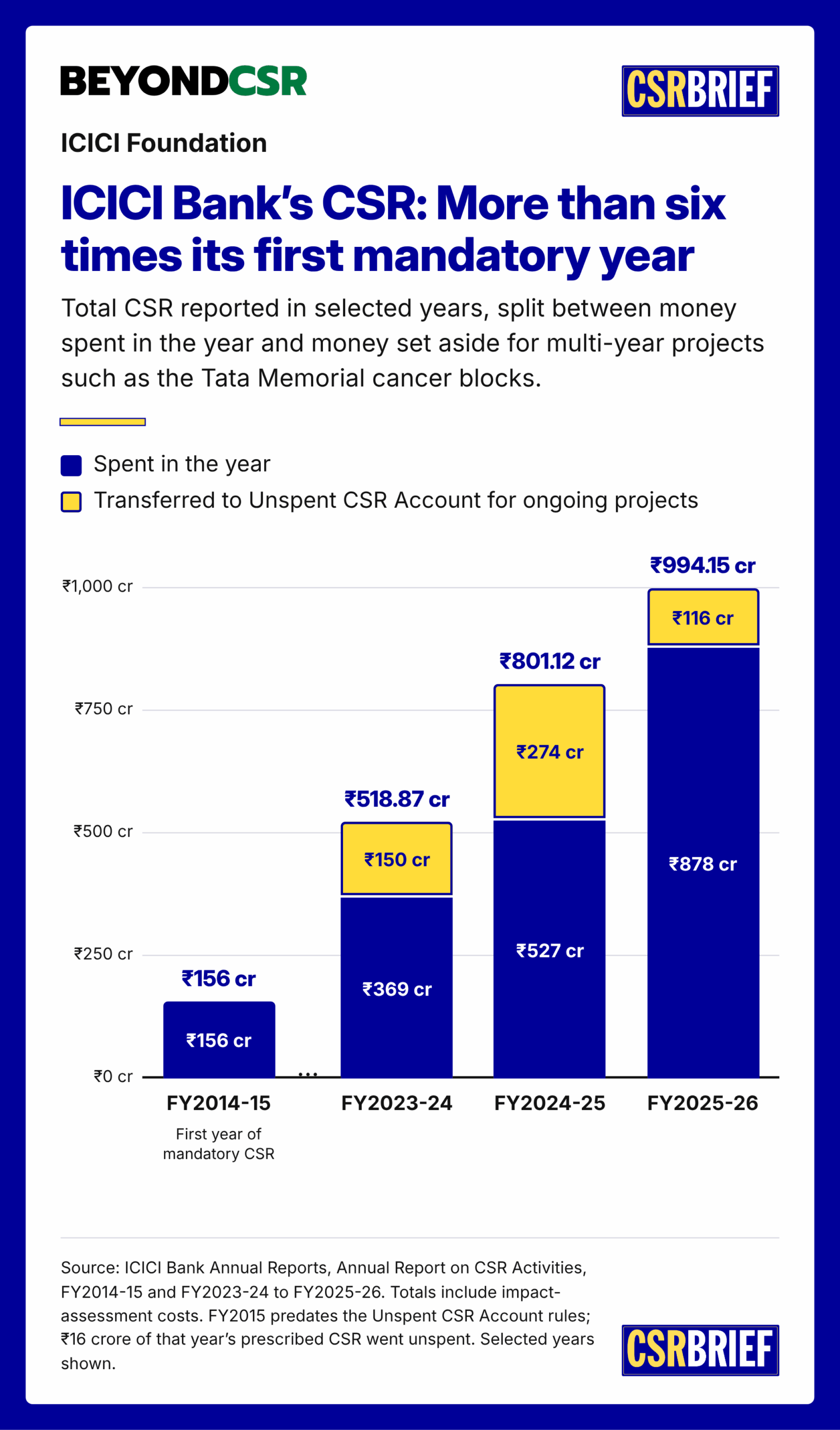
The Bank’s statutory reports separate money spent in the year from money transferred to Unspent CSR Accounts for ongoing projects — a distinction that matters a great deal when the biggest projects are hospital buildings that take years to complete.
| Financial year | Total CSR reported | Spent in the year* | Transferred to Unspent CSR Account |
|---|---|---|---|
| FY2023-24 | ₹518.87 crore | ₹368.87 crore | ₹150.00 crore |
| FY2024-25 | ₹801.12 crore | ₹527.12 crore | ₹274.00 crore |
| FY2025-26 | ₹994.15 crore | ₹878.05 crore | ₹116.10 crore |
*Spent-in-year figures exclude money drawn from earlier years’ Unspent CSR Accounts. Totals include impact-assessment costs. Source: ICICI Bank Board’s Reports, CSR annexures, FY2023-24 to FY2025-26.
ICICI Foundation describes itself as the CSR arm of the ICICI Group, with a Governing Council drawn from senior leaders of the Bank and other Group companies. Each company’s statutory CSR obligation remains its own; the Foundation is the shared vehicle through which much of it is delivered.
What makes the ICICI model distinctive: Institutions that outlast the cheque
Several features set ICICI Foundation apart within this series.
The first is timing. ICICI committed around one per cent of its profits to a foundation in 2007, years before Section 135 made CSR spending mandatory. Like the Tata institutions examined earlier in Beyond CSR, its social commitment came before the law, not because of it.
The second is a banker’s instinct for institutions and systems. From Nachiket Mor’s plan to build institutions that made markets work for the poor, to the RSBY pilot that became a national outpatient benefit, to laboratories inside national skills institutes and cancer blocks inside Tata Memorial Centre, the Foundation has repeatedly chosen to strengthen something that will outlast its own programme.
The third is range in how it delivers. It runs programmes itself, as with the Academy and the RSETIs; it works inside government systems, as with teacher education in Rajasthan and Chhattisgarh; and it backs specialist institutions — TMC, the IITs, ICAR, BNHS — where they know the work better than it does.
The fourth is the scale of its single commitments. ₹1,800 crore to one hospital network is a sum few Indian companies have committed to a single CSR partner.
The fifth is a willingness to publish uncomfortable findings. Job retention of about 44 per cent among Academy graduates, and under-used rehabilitation equipment, are not the numbers a company puts in a brochure. ICICI put them in its Board’s Reports.
And the sixth is the meeting of business and CSR. In the Digital Villages and in its financial-literacy work, the Group has brought banking knowledge to development work, while keeping a commercial loan and a charitable grant on separate sides of the ledger.
Lessons for corporate India from the ICICI journey
The first lesson is that a company does not need to wait for the law. ICICI’s one per cent was a decision, not a compliance requirement, and it gave the Foundation a predictable source of money from the start.
The second is that the most lasting CSR often builds capacity inside someone else’s institution. A laboratory in an NSTI, a block at Tata Memorial or a hub at IIT Bombay keeps serving people when the CSR budget moves on — provided its upkeep is planned from the start, as the oxygen-concentrator programme was.
The third is that measurement should follow people beyond the first result. A placement figure says a trainee got a job; a retention figure says whether the job was worth keeping. The second number is harder to collect and more useful to have.
And the fourth is patience. Hospitals need approvals, construction and commissioning. A company that commits to building one is committing to a timeline longer than any single year’s CSR report.
CSRBrief View – Why this matters: From classrooms to cancer wards, 18 years of building what lasts
ICICI was created in 1955 to build the capacity of Indian industry. Its Foundation has spent eighteen years doing something recognisably similar for India’s social infrastructure, and the range is the point. From government classrooms in Rajasthan and Chhattisgarh to a two-district health pilot that became national policy, from rural training institutes to Industry 4.0 laboratories, and now to cancer wards at Tata Memorial Centre, it has repeatedly chosen to build things that keep working long after the money is spent.
That continuity is what places ICICI Foundation in Beyond CSR. It began with a voluntary pledge of around one per cent of profits, made before the law required one, a founder who wanted markets to work for the poor, and a team of two. Today it is the engine of a CSR budget of ₹994 crore a year, with reported reach of nearly two crore people.
The test now is 2027. When the Tata Memorial blocks open, the measure of ICICI’s largest commitment will be the patients who no longer have to travel across the country for treatment, and the waiting lists that get shorter. On the evidence of its first assessed asset at ACTREC — waits cut from ten days to one — that is a test the Foundation is well placed to welcome.
ICICI Foundation at a glance
- ICICI origins: 1955, as a development financial institution formed at the initiative of the World Bank, the Government of India and Indian industry
- ICICI Foundation for Inclusive Growth: Set up in 2007–08; founding President Nachiket Mor, with effect from 22 October 2007
- Founding funding commitment: Around 1% of the ICICI Group’s profit after tax each year, made in 2007 — before Section 135 of the Companies Act, 2013
- President, ICICI Foundation: Sanjay Datta (as named in 2023 and 2025 announcements)
- Reported cumulative reach: 1.983 crore people by 31 March 2026 (ICICI Bank)
- ICICI Bank CSR spending: ₹994.15 crore in FY2025-26 against an obligation of ₹992.23 crore; ₹801.12 crore in FY2024-25, of which ₹797.49 crore was channelled through ICICI Foundation
- Tata Memorial Centre commitment: ₹1,800 crore for three blocks in Navi Mumbai, Mullanpur and Visakhapatnam — 10.7 lakh sq ft, 19 linear accelerators and 555 beds; completion expected 2027
- Healthcare: 600 hospitals supported since 2020; five lakh people reached in FY2025-26
- Skills: ICICI Academy for Skills since 2013; RSETIs in Udaipur and Jodhpur since 2011; 22 Industry 4.0 laboratories across nine NSTIs; 3.54 lakh people reached through skilling and livelihoods in FY2025-26
- Research: ₹70 crore IITB-ICICI BETIC Hub at IIT Bombay; digital health with IIT Kanpur; research facilities at IIT Delhi
- Environment: 34.37 billion litres of water recharge and storage capacity; around 50 lakh trees since FY2021-22; 83 forests and tiger reserves in 21 states
- Financial literacy: More than 6.9 lakh people trained through 18,838 sessions in FY2023-24 and FY2024-25, two-thirds of them women
ICICI Foundation: Key milestones, 1955 to 2027
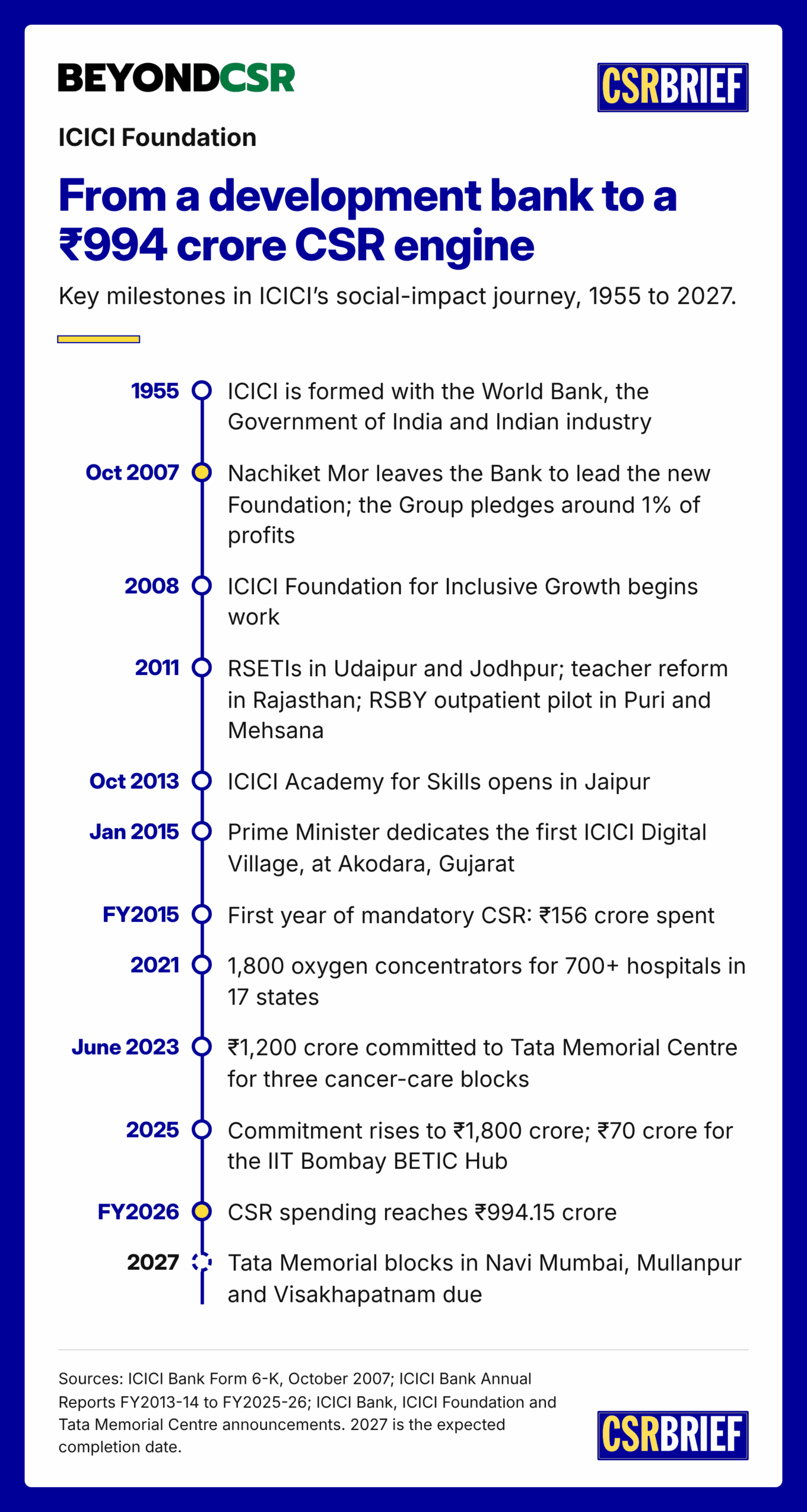
- 1955: ICICI is formed at the initiative of the World Bank, the Government of India and Indian industry to provide project finance to Indian businesses.
- 1994: ICICI Bank is incorporated.
- 1996: N Vaghul, then ICICI Chairman, becomes a trustee of Pratham.
- 2002: ICICI merges into ICICI Bank.
- October 2007: Nachiket Mor steps away from the post of Deputy Managing Director to lead the new ICICI Foundation for Inclusive Growth; the Group commits around 1% of annual profit after tax to it.
- 2008: ICICI Foundation begins work, partnering institutions such as IFMR Trust and Grameen Capital India.
- 2010: The ICICI Fellows rural leadership programme begins.
- March 2011: The Foundation begins managing ICICI’s RSETIs in Udaipur and Jodhpur.
- 2011–12: Six-year school and teacher education reform partnerships begin with Rajasthan (April 2011) and Chhattisgarh (July 2012).
- July 2011: The outpatient healthcare pilot on the RSBY platform begins in Puri, followed by Mehsana in November 2011; the Central government later extends outpatient care to all RSBY-empanelled hospitals.
- 4 October 2013: The ICICI Academy for Skills launches in Jaipur; 1,015 trainees complete courses by March 2014.
- 2 January 2015: Prime Minister Narendra Modi dedicates ICICI’s first Digital Village, at Akodara, Gujarat, to the nation.
- FY2014-15: In the first year of mandatory CSR, ICICI Bank’s prescribed CSR is ₹172 crore; it spends ₹156 crore.
- May 2015: A women-only Academy centre opens in Lucknow.
- 2016: The rural livelihood programme begins.
- 2017: The ICICI Group dedicates 100 ICICI Digital Villages.
- February 2020: The Foundation signs an agreement with the Indian Council of Agricultural Research.
- 2021: The Foundation announces 1,800 oxygen concentrators for more than 700 sub-divisional hospitals in 17 states.
- 5 June 2023: ICICI Bank commits ₹1,200 crore to Tata Memorial Centre for three cancer-care blocks.
- September 2023: The Foundation and IIT Kanpur sign their digital-health agreement.
- June 2025: The foundation stone for the ₹550 crore Visakhapatnam block is laid; the TMC commitment rises to ₹1,800 crore.
- July 2025: ICICI Foundation pledges ₹70 crore for the IITB-ICICI BETIC Hub at IIT Bombay.
- October 2025: ICICI Bank announces ₹625 crore for the Navi Mumbai radiation-oncology block.
- FY2025-26: ICICI Bank’s CSR spending reaches ₹994.15 crore; cumulative reach is reported at 1.983 crore people.
- 2027: Tata Memorial blocks in Navi Mumbai, Mullanpur and Visakhapatnam due for completion.
Editor’s note
This DeepDive has been developed through detailed research based on publicly available information, including ICICI Bank’s annual reports, Board’s Reports and ESG reports, ICICI Foundation’s programme case studies, announcements by ICICI Bank, ICICI Foundation, Tata Memorial Centre and IIT Bombay, contemporaneous reporting on the Foundation’s founding in 2007–08, and independent CSR-sector coverage. Reach, beneficiary and capacity figures are as reported by ICICI Bank or ICICI Foundation; findings from external assessments are identified as such.
The spending table and the impact-assessment findings have been checked against the CSR annexures to ICICI Bank’s Board’s Reports for FY2023-24, FY2024-25 and FY2025-26. The FY2023-24 total of ₹518.87 crore includes ₹0.88 crore spent on impact assessments; the figure of ₹517.99 crore sometimes reported is project spending alone. The Bank’s own cumulative figures for the ICICI Academy for Skills have been reported on different bases over the years, so we have relied on the dated external assessment rather than a single lifetime total.
The primary documents behind this DeepDive are listed on our CSR source documents page.
We have made every effort to verify facts, dates, figures and programme details, but we regret any inadvertent error or omission. CSRBrief would be happy to receive any factual clarification or correction. Please email us, and we will review and correct where warranted. Substantive corrections carry a dated note on the story.
About Beyond CSR
Beyond CSR is a CSRBrief editorial franchise examining the most significant CSR engines shaping social impact in India: companies, foundations and flagship programmes worth understanding because of their scale, longevity, innovation, institutional depth, replicability and impact.
It is not a ranking by CSR expenditure. Each DeepDive examines what was built, how the model developed, what kind of impact it created, what has endured, how it continues to evolve and what others can learn from it.
We hope that for everyone interested in and working with CSR, Beyond CSR becomes much more valuable than a conventional ‘Top CSR companies’ list.