


CSRBrief’s Beyond CSR series looks at the Aga Khan Development Network (AKDN) — among the most significant engines that have been shaping social impact in India for 120 years now.
- How AKDN’s India story took shape
- A core guiding value for AKDN: Pluralism
- A recent transition: From Aga Khan IV to Aga Khan V
- The Aga Khan IV awarded the Padma Vibhushan
- Rural development and livelihoods: The Aga Khan Rural Support Programme (India)
- Education: From Mundra’s first school to the Aga Khan Academy Hyderabad
- Culture and heritage: Restoring Humayun’s Tomb and reviving Nizamuddin
- Habitat, health and sanitation: Building resilience alongside dignity
- Not an Indian company, but a significant social-impact engine
- What makes AKDN’s India model distinctive
- Lessons for corporate India from AKDN’s journey
- CSRBrief View – Why this matters: 120 years of quiet institution-building
- AKDN in India at a glance
- AKDN: Key milestones in India, 1905 to 2026
- Editor’s note
- About Beyond CSR
How AKDN’s India story took shape
In 1905, Sultan Muhammad Shah, Aga Khan III, established the first Aga Khan school in Mundra, a small town on the Gujarat coast. It was, at the time, simply a school. It became the starting point of what is today one of the longest-running institution-building efforts in India, predating the country’s independence by more than four decades.
The formal structures came much later. The Aga Khan Foundation (AKF) itself was established in 1967 by Aga Khan IV as the first agency of what would become AKDN, bringing together health, education and rural-development work under one institutional umbrella. The Aga Khan Education Service, India (AKES, India) was formally established in 1986, tracing its own lineage back to that 1905 Mundra school. The Aga Khan Rural Support Programme (India), or AKRSP(I), was set up in 1983 and began field operations in Gujarat in 1985.
That sequence — school first, formal network decades later — mirrors a pattern this series has seen before: an idea beginning small, and institutional structure catching up to it over time rather than preceding it (see CSRBrief’s Tata Trusts feature [link once live]).
Today, eight of AKDN’s 11 global agencies operate in India: the Aga Khan Foundation, Aga Khan Education Services, Aga Khan Health Services, Aga Khan Agency for Habitat, Aga Khan Agency for Microfinance, Aga Khan Trust for Culture, the Aga Khan Academies, and the Aga Khan Rural Support Programme (India).
A core guiding value for AKDN: Pluralism
Underpinning all of AKDN’s work, in India and elsewhere, is a guiding value the network describes as pluralism. Aga Khan IV founded the Global Centre for Pluralism in Ottawa in 2006, jointly with the Government of Canada, to research and promote the idea internationally; at the Centre’s 2017 reopening, he said pluralism “does not mean the elimination of difference, but the embrace of difference,” arguing that genuine diversity “does not weaken a society, it strengthens it.”
Independent academic study of AKDN’s programmes has described the network as guided by this core value, with people from diverse religious, ethnic and other backgrounds included in its work regardless of community affiliation — a principle visible in India in the Aga Khan Rural Support Programme’s own experience building rural institutions across Ismaili, Sunni and non-Ismaili Shia communities alike, rather than confining its work to any single religious community.
A recent transition: From Aga Khan IV to Aga Khan V
Any account of this institution written today has to account for a significant, very recent change at its centre.
Aga Khan IV, born Shah Karim al-Hussaini, led the Nizari Ismaili Muslim community as its 49th hereditary Imam from 1957, and chaired the Aga Khan Development Network he founded, for 68 years. He died on 4 February 2025 in Lisbon, at the age of 88. In keeping with the Ismaili tradition of Nass — the explicit designation of a successor by the sitting Imam — his will named his son, Prince Rahim al-Hussaini, as his successor. His Highness Prince Rahim al-Hussaini was installed as Aga Khan V — formally, His Highness Prince Rahim Aga Khan V, the 50th hereditary Imam of the Shia Ismaili Muslims and Chair of the Aga Khan Development Network — on 11 February 2025.
(Story updated on 9 September 2016: His Highness Prince Rahim Aga Khan met with Prime Minister Narendra Modi, President Draupadi Murmu, Vice-President C P Radhakrishnan, Union Home Minister Amit Shah and External Affairs Minister Dr Subrahmanyam Jaishankar.

The meetings marked His Highness’s first official engagement with India’s leadership since becoming the 50th hereditary Imam of the Shia Ismaili Muslims and Chair of the Aga Khan Development Network in February 2025. Read here)
The Aga Khan IV awarded the Padma Vibhushan
Aga Khan IV’s contribution to India was formally recognised by the Government of India on 8 April 2015, when President Pranab Mukherjee awarded him the Padma Vibhushan at Rashtrapati Bhavan in New Delhi, as part of the country’s 66th Republic Day honours.
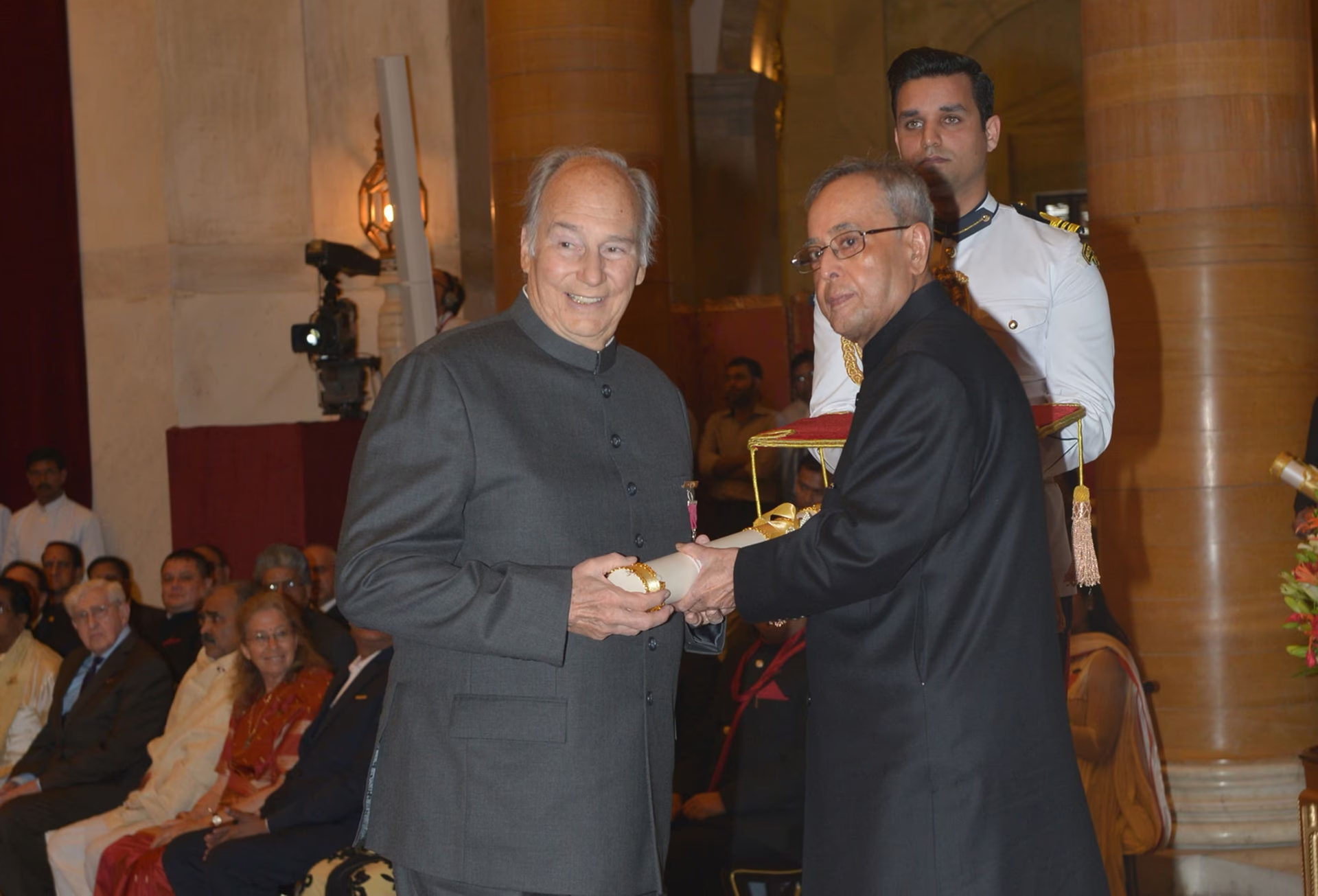
The citation recognised his contributions to social development in India specifically, citing AKDN’s then-century-long presence in the country. Fellow recipients that year included actor Amitabh Bachchan and nuclear scientist M R Srinivasan.
The award followed, by a single day, a foundation-stone ceremony for the new Site Museum at the Humayun’s Tomb complex in Delhi — the same restoration project that Beyond Series has already noted was co-funded by the Sir Dorabji Tata Trust.
More from Beyond CSR
- Tata Trusts: 134 remarkable years of shaping India
- HDFC Bank Parivartan: 10 years of building CSR into a long-term social-impact platform
- Aga Khan Development Network: 120 years of social impact in India
- SBI Foundation: 220 years from the Bank of Calcutta to a ₹709 crore CSR platform
- ICICI Foundation: From a 1955 development bank to a ₹994 crore engine of inclusive growth
Rural development and livelihoods: The Aga Khan Rural Support Programme (India)
The Aga Khan Rural Support Programme (India), AKRSP(I), is the Network’s largest and longest-running India programme by reach. Set up in 1983 and operational since 1985, it now works in more than 3,250 villages across Gujarat, Madhya Pradesh, Bihar and Maharashtra, and reports having reached between 3.5 and 4 million people.
More than 80% of the households AKRSP(I) works with belong to marginalised communities — tribal, Dalit and minority groups — and more than 60% of beneficiaries are women, who the programme treats as a core constituency for its interventions rather than an incidental one.
The programme’s work spans natural-resource management, climate adaptation, sustainable agriculture, livestock development, rural governance, financial inclusion, water and sanitation. It has also been externally recognised: in 2015, AKRSP(I) received the Times of India Social Impact Award for improving access to safe drinking water and sanitation for more than 350,000 people in Bihar and Gujarat, part of a broader AKDN Comprehensive Sanitation Initiative launched that year across six Indian states, which set out to bring sanitation access to 100,000 families and helped lift rural sanitation coverage in its project areas from 42% to more than 60% within two years.
AKRSP(I)’s own reporting notes that goat-rearing and dairy interventions in Madhya Pradesh and Uttar Pradesh have helped families earn up to $500 a year in additional income, and that Self Help Group-run solar-powered irrigation schemes, such as one in Muzaffarpur, Bihar, have extended its natural-resource work into renewable energy.
Education: From Mundra’s first school to the Aga Khan Academy Hyderabad
AKES, India: A century of schools
The Aga Khan Education Service, India today operates eight schools, 19 preschools and one residential hostel across Gujarat, Maharashtra and Telangana, educating more than 8,000 students from Nursery to Grade 12 on both state and national curricula.
The schools’ reach extends beyond their own student bodies. In March 2026, AKES, India was reported to have contributed to the Government of Gujarat’s statewide rollout of the ‘Aadharshila’ curriculum — a state-government partnership built on the network’s own century of classroom experience in the state where it began.
The Aga Khan Academy, Hyderabad
A different kind of institution altogether is the Aga Khan Academy, Hyderabad, established in 2011 on a 100-acre campus near Rajiv Gandhi International Airport. It is the second in a global network of Aga Khan Academies, offering the International Baccalaureate curriculum on a means-blind, merit-based admissions model — financial aid is available regardless of a student’s economic background.
Beyond its own enrolment, the Academy runs an outreach programme extending modern teaching methods to government and other schools in the region, part of a wider Aga Khan Academies network that has trained more than 2,000 teachers globally through links to some 1,000 schools.
Culture and heritage: Restoring Humayun’s Tomb and reviving Nizamuddin
The Aga Khan Trust for Culture’s (AKTC) work in India is anchored by one of its most visible achievements anywhere in the world: the restoration of Humayun’s Tomb in Delhi.
In 1997, on the 50th anniversary of India’s independence, Aga Khan IV pledged to restore the gardens surrounding Humayun’s Tomb — a commitment that set in motion nearly three decades of continuous work on the site and its surrounding precinct.
Garden restoration work at the 16th-century Mughal monument was completed in 2003. In 2007, AKTC signed a public-private partnership with the Archaeological Survey of India, the Central Public Works Department and the Municipal Corporation of Delhi — following discussions between Aga Khan IV and then Prime Minister Manmohan Singh that began in 2004 — to undertake full conservation of the tomb itself. That work, completed in 2013, required removing a million kilograms of concrete that 20th-century repairs had added to the structure’s roof, walls and ceilings, in order to restore the Mughal builders’ original design.
The Humayun’s Tomb conservation was co-funded by the Sir Dorabji Tata Trust — one of the founding trusts profiled in this series’ very first entry — in partnership with the Archaeological Survey of India, a direct link between two of Beyond CSR’s subjects working on the same monument.
The project grew into something considerably larger than the tomb itself: the wider Nizamuddin Urban Renewal Initiative, which redeveloped the adjoining Sunder Nursery into a 90-acre city park, restored more than 60 monuments across Delhi in total, and paired the conservation work with a socio-economic development programme in the neighbouring Hazrat Nizamuddin Basti covering health, education and sanitation. Before the initiative began, close to half the children in the Basti were found to be underweight, one in four households had no home toilet, and fewer than 60% of babies were delivered in a medical facility.
The Humayun’s Tomb complex now draws more than three million visitors a year — a number that prompted the construction of a dedicated site museum at the entrance to the World Heritage Site, part-funded by a Rs 49 crore commitment from India’s Ministry of Tourism.
AKTC’s heritage model has since extended beyond Delhi. In Hyderabad, the Trust spent more than a decade — from 2013 — conserving the Qutb Shahi Heritage Park, a 106-acre necropolis containing 40 mausoleums and 23 mosques. The completed park was formally inaugurated on 28 July 2024, with Prince Rahim Aga Khan and Telangana Chief Minister Revanth Reddy both present.
The project drew support beyond AKTC itself: funders included the Sir Dorabji Tata Trust and IndiGo Reach/InterGlobe Foundation — a second corporate and philanthropic link to subjects already covered elsewhere in this series.
Habitat, health and sanitation: Building resilience alongside dignity
The Aga Khan Agency for Habitat (AKAH), formally established in 2016, works in India alongside AKF and AKRSP(I) on housing design, disaster resilience, water supply and sanitation in some of the country’s most environmentally vulnerable areas — including green-building demonstration projects in Gujarat and Telangana that combine cool-roof coatings with vertical and rooftop gardening to counter urban heat.
Aga Khan Health Services (AKHS), one of three AKDN agencies working in health alongside the Foundation and Aga Khan University, began its work in the 1920s and operates the Prince Aly Khan Hospital in Mumbai — a 137-bed multi-speciality acute-care facility established in 1945. Globally, AKHS operates as part of a network that, across all the countries it serves, provides healthcare to more than 14 million people a year through more than 575 outreach health centres.
These agencies rarely work in isolation from each other. The Comprehensive Sanitation Initiative launched in 2015 was explicitly designed to combine AKF, AKRSP(I), AKAH and AKHS’s separate areas of expertise — water, sanitation infrastructure, community mobilisation and health — into a single programme, the same cross-agency integration visible in AKRSP(I)’s own rural-development model.
Not an Indian company, but a significant social-impact engine
This entry departs from every other subject in this series in one important respect: AKDN is not an Indian corporate entity, nor is it a company’s CSR or philanthropic arm. It is a global network of development agencies, headquartered in Geneva, tied to the institutional leadership of the Ismaili Imamat, active in 17 countries beyond India.
Beyond CSR’s very first entry, on Tata Trusts, established that this series is concerned with significant CSR and social-impact engines shaping India — not narrowly with statutory corporate CSR under Section 135 of the Companies Act. By that standard, AKDN’s inclusion follows the same logic that justified Tata Trusts’ place at the start of this series: a philanthropic institution, not a company, whose sustained work has shaped Indian communities for longer than almost any Indian corporate CSR programme has existed.
AKDN’s institutions have repeatedly worked alongside major Indian companies without their own name becoming the headline. The Aga Khan Foundation partnered with HDFC Bank Parivartan on a rural water-supply scheme across Lucknow and Sitapur in Uttar Pradesh, reaching 40,000 people, according to HDFC’s own CSR reporting; and the Sir Dorabji Tata Trust co-funded AKTC’s restoration of Humayun’s Tomb. An institution that keeps surfacing as a trusted partner to major Indian companies and philanthropic institutions is, on its own, a reasonable case for examining it directly.
What makes AKDN’s India model distinctive
Several qualities stand out.
The first is genuine longevity, predating almost every other institution in this series. The 1905 Mundra school origin gives AKDN’s India presence a longer continuous history than Tata Trusts’ own 1892 starting point is often credited with in popular accounts, even though the formal Tata Trusts structures (1919 onward) predate AKF’s formal 1967 founding.
The second is structural breadth without a single corporate parent. Where every other subject in this series traces back to one company or family business, AKDN’s India work is delivered through eight distinct, specialised agencies — education, rural support, habitat, health, microfinance and culture — coordinated centrally but operationally separate.
The third is a demonstrated ability to work inside government systems rather than beside them: the Nizamuddin restoration was built on a public-private partnership with the Archaeological Survey of India and Delhi’s municipal bodies; the Gujarat curriculum contribution works directly with a state education department; the Comprehensive Sanitation Initiative was designed to support the Government of India’s own sanitation targets.
The fourth is a demonstrated capacity to absorb leadership transition without visible disruption to programme delivery — a test this institution is living through in real time following Aga Khan IV’s death in February 2025, structured specifically to be survivable by an institution built to outlast any one leader’s tenure.
Lessons for corporate India from AKDN’s journey
The most transferable lesson is about institutional structure itself: breadth does not require a single controlling entity. AKDN’s India work spans agriculture, education, health, habitat and heritage precisely because it is organised as a network of specialists rather than one generalist body trying to do all of it.
The second is that cultural and heritage investment can be paired with, rather than separated from, hard development outcomes. The Nizamuddin project shows a heritage-restoration budget deliberately tied to child-nutrition, sanitation and education outcomes in the surrounding community — heritage as a development lever, not a standalone cause.
The third is that meaningful CSR partnerships do not require ownership. The Aga Khan Foundation’s partnership with HDFC Bank Parivartan on rural water supply, and the Aga Khan Trust for Culture’s more recent partnership with IndiGo at Gwalior Fort, show the same principle extending from rural infrastructure into heritage conservation — without either institution needing to be Indian, corporate, or newly arrived. A long, credible track record travels on its own.
CSRBrief View – Why this matters: 120 years of quiet institution-building
AKDN represents long-term, multi-sector institution-building rather than a conventional CSR programme. Its India story is significant for its longevity, breadth and institutional depth. Over 120 years, its work has expanded across education, rural development, health, habitat and cultural heritage.
For Beyond CSR, the larger lesson from AKDN’s India journey is simple: sustained social investment can build institutions, deepen capability and create impact that lasts across generations.
AKDN in India at a glance
- Earliest India presence: 1905, first Aga Khan school, Mundra, Gujarat
- Aga Khan Foundation founded: 1967, by Aga Khan IV
- Current leadership: His Highness Prince Rahim Aga Khan V, 50th hereditary Imam of the Shia Ismaili Muslims and Chair of the Aga Khan Development Network, installed 11 February 2025, following the death of Aga Khan IV on 4 February 2025
- AKDN agencies active in India: 8 of 11 global agencies
- AKRSP(I): established 1983, operational 1985; 3,250+ villages, 3.5 to 4 million people reached, across Gujarat, Madhya Pradesh, Bihar and Maharashtra
- AKES, India: established 1986; 8 schools, 19 preschools, 1 hostel; 8,000+ students across Gujarat, Maharashtra and Telangana
- Aga Khan Academy, Hyderabad: established 2011; 100-acre campus; International Baccalaureate curriculum; means-blind admissions
- Aga Khan Trust for Culture: 50+ monuments restored in Delhi, including Humayun’s Tomb (completed 2013), co-funded by the Sir Dorabji Tata Trust
- Humayun’s Tomb, Sunder Nursery and Nizamuddin Basti precinct: More than 3 million visitors annually
- Comprehensive Sanitation Initiative (2015): 6 Indian states; targeted 100,000 families; rural sanitation coverage in project areas rose from 42% to 60%+ within two years
- 2015 recognition: Times of India Social Impact Award to AKRSP(I) for water and sanitation access for 350,000+ people in Bihar and Gujarat
AKDN: Key milestones in India, 1905 to 2026
- 1905: The first Aga Khan school opens in Mundra, Gujarat, founded by Aga Khan III.
- 1957: Aga Khan IV becomes the 49th hereditary Imam of the Nizari Ismaili Muslims, aged 20.
- 1967: Aga Khan IV establishes the Aga Khan Foundation, the first agency of what becomes AKDN.
- 1983-85: The Aga Khan Rural Support Programme (India) is established and begins field operations in Gujarat.
- 1986: Aga Khan Education Service, India is formally established, building on the 1905 Mundra school.
- 2003: Garden restoration at Humayun’s Tomb, Delhi, is completed.
- 2007: A public-private partnership with the Archaeological Survey of India and Delhi civic bodies begins full conservation of Humayun’s Tomb and the wider Nizamuddin Urban Renewal Initiative.
- 2011: The Aga Khan Academy, Hyderabad opens on a 100-acre campus.
- 2013: Humayun’s Tomb conservation is completed, co-funded by the Sir Dorabji Tata Trust.
- 2015: AKDN’s Comprehensive Sanitation Initiative launches across six Indian states; AKRSP(I) wins the Times of India Social Impact Award.
- 2016: The Aga Khan Agency for Habitat is formally established as an AKDN agency.
- February 2025: Aga Khan IV dies in Lisbon at age 88; his son is installed as Aga Khan V on 11 February 2025.
- March 2026: Aga Khan Education Service, India contributes to the Government of Gujarat’s statewide ‘Aadharshila’ curriculum rollout.
Editor’s note
This DeepDive has been developed through detailed research based on publicly available information, including AKDN’s own official website and country-specific India pages, the Aga Khan Foundation’s country reports, Aga Khan Rural Support Programme (India)’s own published fact sheets, Aga Khan Education Service India’s website, Aga Khan Trust for Culture’s project documentation, and independent reporting on the February 2025 succession of Aga Khan V. It is intended as a considered look at the social responsibility and impact of an institution whose work in India spans more than a century, and which — unlike every other subject in this series — is not an Indian corporate entity.
We have made every effort to verify facts, dates, figures and programme details, but we regret any inadvertent error or omission. CSRBrief would be happy to receive any factual clarification or correction. Please email us, and we will review and correct where warranted. Substantive corrections carry a dated note on the story.
Story updated on 13 September 2026: Corrected an earlier error attributing an Aga Khan Foundation water-supply partnership to Reliance Foundation — it is with HDFC Bank Parivartan. Refreshed AKRSP(I)’s reach figures, the Humayun’s Tomb visitor count and monument total against AKDN’s own current reporting. Added new material on the Aga Khan Trust for Culture’s work at the Qutb Shahi Heritage Park, Hyderabad, and on the Prince Aly Khan Hospital, Mumbai.
About Beyond CSR
Beyond CSR is a CSRBrief editorial franchise examining the most significant CSR engines shaping social impact in India: companies, foundations and flagship programmes worth understanding because of their scale, longevity, innovation, institutional depth, replicability and impact.
It is not a ranking by CSR expenditure. Each DeepDive examines what was built, how the model developed, what kind of impact it created, what has endured, how it continues to evolve and what others can learn from it.
We hope that for everyone interested in and working with CSR, Beyond CSR becomes much more valuable than a conventional ‘Top CSR companies’ list.